The Ultimate AI Flow Chart Explained Simply: From Machine Learning to AI Agents (2026 Guide)
Confused by tech jargon? This simple guide breaks down the complete AI ecosystem. Learn how Machine Learning, Deep Learning, LLMs, RAG, and AI Agents connect—without any complex math or heavy theory.
The AI Flow Chart: How Everything Fits Together
If you have spent even five minutes on LinkedIn, X, or tech news recently, you have probably been bombarded with an absolute alphabet soup of terms. AI, ML, Deep Learning, LLMs, RAG, MCP, AI Agents… the list never seems to stop growing.
It feels like every single week a new acronym pops up, and everyone acts like you should already know what it means. It gets confusing fast. You start wondering: Is an LLM different from Machine Learning? Where does RAG fit in? What on earth is MCP?
Here is the reality check: AI is not one giant, magical black box. It is a clean hierarchy. Once you see how the layers stack on top of each other, the entire tech landscape suddenly makes complete sense.
The Master Map: The Complete AI Ecosystem
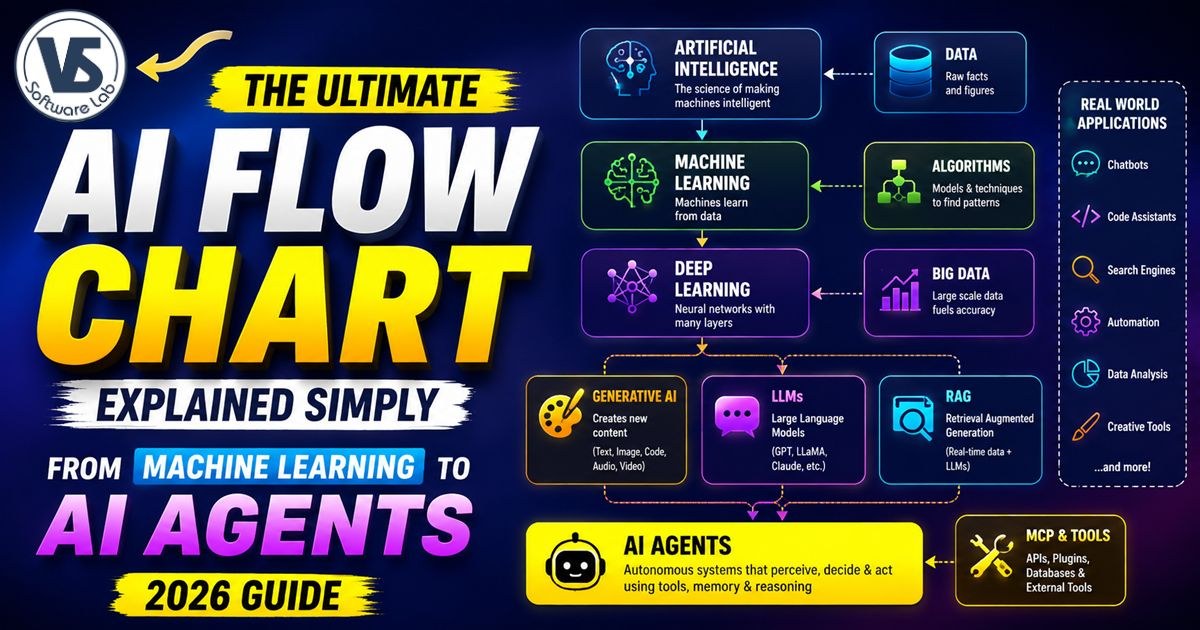
Before we dive into the details, take a look at this breakdown. This flowchart maps out exactly how every core concept—from foundational algorithms to modern tools like AI Agents—connects back to Artificial Intelligence.
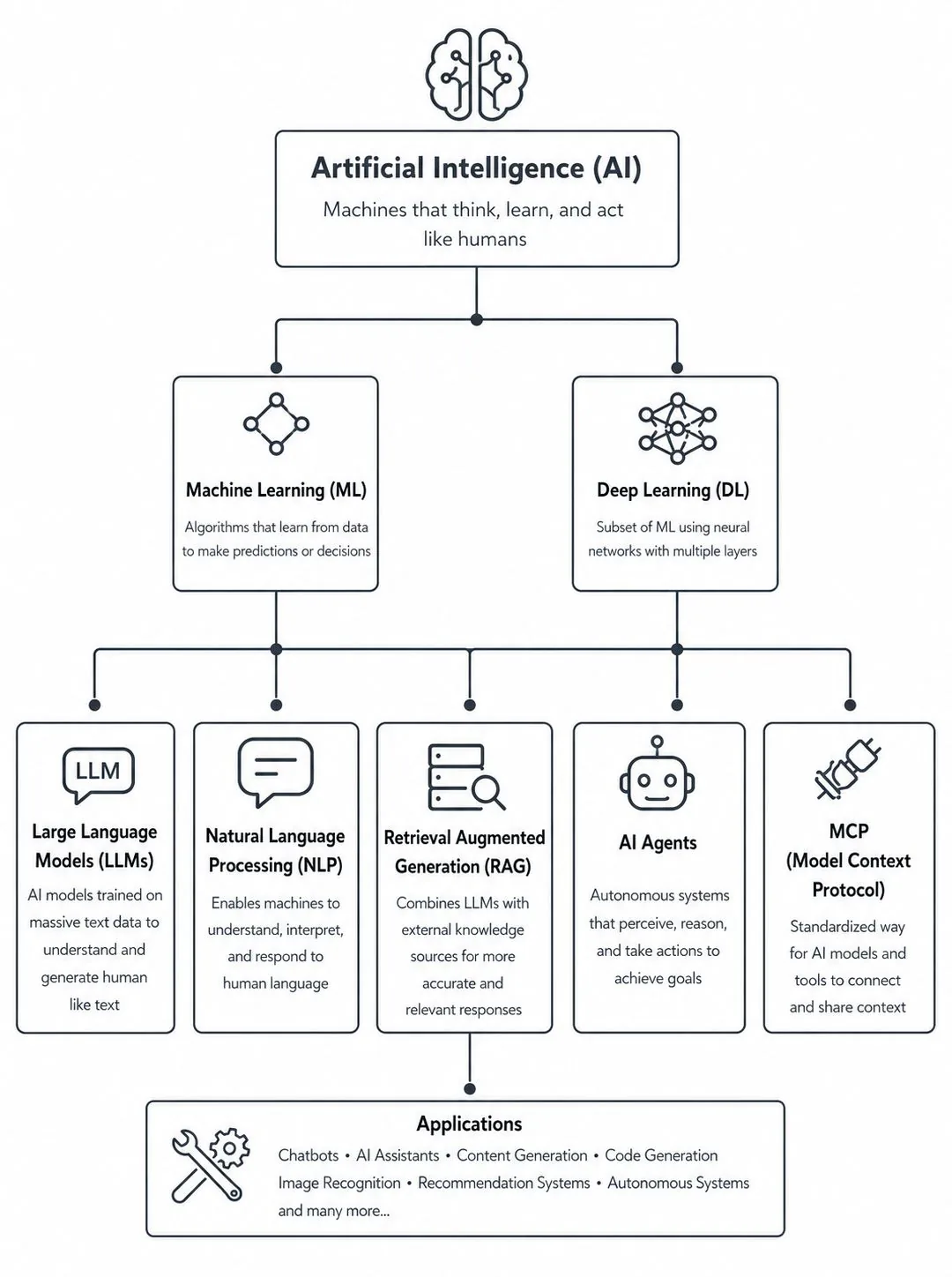
Figure: The Modern AI Stack mapped from core concepts to real-world applications.
Think of this post as your personal guide to this flowchart. We will walk through every single block on this map, top to bottom, using practical analogies instead of textbook math.
1. The Big Umbrella: Artificial Intelligence (AI)
At the very top of our flowchart sits Artificial Intelligence (AI). As the chart notes, this simply refers to "machines that think, learn, and act like humans."
AI is not a specific software tool or a single line of code. It is the overall goal—the umbrella term for any technique that makes a computer act intelligently.
A Quick Analogy: Think of "AI" like the word "Medicine." Medicine isn't a single pill; it covers surgery, vaccines, antibiotics, and therapy. AI is the broad field, and everything below it on the chart is just a specialized discipline within it.
2. The Foundation: Machine Learning & Deep Learning
Moving one level down on our chart, we split the main engine of modern AI into two distinct building blocks: Machine Learning (ML) and Deep Learning (DL). While people often use these terms interchangeably, they handle data in fundamentally different ways.
Machine Learning (ML): Teaching Computers to Learn from Experience
Traditionally, software development required programmers to write explicit, hard-coded rules: "If X happens, do Y." If you wanted a computer to detect fraudulent bank transactions, you had to manually code thousands of strict conditions.
Machine Learning flips this approach entirely. Instead of writing rules, you feed the computer massive amounts of historical data and let the algorithm discover the patterns on its own.
As highlighted in the flowchart, ML consists of "algorithms that learn from data to make predictions or decisions."
- How it works in the real world: Spotify doesn't have a human curated playlist team hand-picking tracks for all 600+ million users. Instead, its ML models analyze what millions of people with similar taste listen to, spot subtle listening trends, and predict what songs you will enjoy next.
- The core limitation: Traditional ML models require structured data and a lot of manual tweaking (called feature engineering). If you give a standard ML algorithm a raw, unstructured photo, it usually struggles to figure out what it is looking at without human help.
Deep Learning (DL): The Neural Engine Behind Breakthroughs
This brings us to Deep Learning—a specialized sub-field of Machine Learning designed to handle messy, real-world data like raw images, audio recordings, and massive collections of text.
The flowchart defines DL as a "subset of ML using neural networks with multiple layers."
These "neural networks" are loosely inspired by the biological architecture of the human brain. By stacking dozens or even hundreds of mathematical layers together, Deep Learning models can automatically break down complex information into simple visual or semantic pieces.
How a Deep Learning Neural Network "Sees" an Image:
- Layer 1: Detects basic edges, dark lines, and basic contrast.
- Layer 2: Combines those edges to identify shapes like circles, corners, or curves.
- Layer 3: Assembles those shapes into recognizable features like eyes, wheels, or letters.
- Final Layer: Combines every feature to say with high confidence: "This is a photo of a golden retriever."
Without Deep Learning, modern breakthroughs like self-driving cars, real-time voice translation, and facial recognition simply would not exist. More importantly, Deep Learning serves as the technical engine that makes everything on the next layer of our flowchart possible—including Large Language Models.
3. The Frontier Layer: LLMs, NLP, RAG, Agents & MCP
Now we reach the layer where most of today's excitement (and confusion) lives. Once Deep Learning paved the way, researchers used it to build specialized frameworks designed to process text, reason through tasks, and execute real actions.
Let's break down these five interconnected pillars from left to right on our flowchart.
1. Large Language Models (LLMs)
Flowchart definition: "AI models trained on massive text data to understand and generate human-like text."
Think of an LLM as a giant pattern-recognition machine for human language. By reading billions of pages from the internet, books, and code repositories, models like GPT-4, Claude, or Gemini learned how words relate to each other.
When you ask an LLM a question, it isn't "thinking" in the human sense—it is calculating probability. It looks at your prompt and predicts the most helpful, logical sequence of words to write next.
2. Natural Language Processing (NLP)
Flowchart definition: "Enables machines to understand, interpret, and respond to human language."
While LLMs are the shiny engines powering today's conversational AI, NLP is the broader field of study behind them. NLP deals with everything from basic grammar checking and sentiment analysis (is a product review positive or negative?) to language translation and speech recognition.
In short: NLP is the discipline; LLMs are currently its most powerful tool.
3. Retrieval Augmented Generation (RAG)
Flowchart definition: "Combines LLMs with external knowledge sources for more accurate and relevant responses."
Standard LLMs have two major drawbacks: they can confidently make things up (called "hallucinations"), and their knowledge stops at the date they were trained. You can't ask a raw LLM about your company's internal HR policy or yesterday's sales figures because it simply doesn't have access to that data.
This is where RAG comes in.
Instead of relying purely on what the LLM memorized during training, RAG acts like an open-book exam. When you ask a question, the RAG system first searches your specific database or document collection for relevant context, pastes that context into the prompt behind the scenes, and then asks the LLM to write a answer based only on those facts.
4. AI Agents
Flowchart definition: "Autonomous systems that perceive, reason, and take actions to achieve goals."
Standard chatbots are passive—they only reply when you talk to them. AI Agents are active. You give an agent a high-level goal, and it breaks that goal down into smaller steps, executes them independently, and adapts if something goes wrong.
Chatbot vs. AI Agent:
- Chatbot: You ask, "Find me flights to Goa next Friday." It gives you a list of links.
- AI Agent: You say, "Book the cheapest morning flight to Goa next Friday and block my calendar." The agent checks flight APIs, selects the best option, processes the booking, and creates a Google Calendar invite automatically.
5. Model Context Protocol (MCP)
Flowchart definition: "Standardized way for AI models and tools to connect and share context."
As AI Agents and LLMs started connecting to external databases, web browsers, and software tools, developers hit a major bottleneck: every single integration required custom, messy code. Connecting an AI to Slack was completely different from connecting it to a Postgres database or GitHub.
MCP solves this plug-and-play problem. Think of MCP like a USB-C cable for AI. It provides a single universal standard so any AI model can instantly plug into any tool, data source, or application without developers having to rebuild the connection from scratch every time.
4. The Impact Layer: Real-World Applications
At the bottom of our flowchart sits the layer where all these foundational technologies finally meet everyday reality: Applications.
Every software tool you interact with today doesn't just use one branch of AI. Instead, modern products layer these building blocks together to solve real human problems.
Here is how the concepts on our map power the daily applications we rely on:
- Chatbots & AI Assistants: Built on LLMs and NLP to handle customer support, rewrite documents, or act as instant research companions.
- Content & Code Generation: Harnessing Deep Learning and LLMs to write working Python scripts, draft marketing copy, or generate artwork from simple text prompts.
- Recommendation Systems: Powered by traditional Machine Learning algorithms that curate your Netflix homepage, Amazon product suggestions, and YouTube feeds based on user behavior.
- Image Recognition & Autonomous Systems: Relying heavily on Deep Learning and Computer Vision to help self-driving cars identify pedestrians, or enable medical software to spot anomalies in X-rays.
- Enterprise Knowledge Search: Combining LLMs with RAG so employees can chat directly with thousands of internal company PDFs and extract accurate facts in seconds.
Connecting the Dots: How it All Fits Together
When you step back and look at the complete flowchart, the story becomes clear:
- Artificial Intelligence is the goal.
- Machine Learning & Deep Learning are the engines that make it work.
- LLMs, NLP, RAG, Agents, and MCP are the tools built on top of those engines.
- Applications are the everyday products that put those tools into our hands.
The next time someone drops a buzzword like "RAG" or "AI Agents" into a meeting or a LinkedIn post, you don't need to feel lost. You have the full map.
Frequently Asked Questions (FAQ)
1. What is the main difference between Machine Learning and AI?
Artificial Intelligence (AI) is the broader concept of creating smart machines that can solve problems like humans. Machine Learning (ML) is a specific method used to achieve AI—where computers learn patterns directly from data instead of relying on manually written rules.
2. Are Deep Learning and Generative AI the same thing?
Not quite. Deep Learning is the underlying technical architecture (using multi-layer neural networks). Generative AI—like Large Language Models (LLMs) or image generators—is a specific application built on top of Deep Learning that focuses on creating brand-new content like text, code, or artwork.
3. Why do we need RAG if we already have LLMs?
LLMs are great at understanding language, but they only know what they were trained on and can sometimes make things up (hallucinate). RAG (Retrieval-Augmented Generation) connects an LLM directly to your custom documents or private databases, allowing it to give accurate, fact-based answers using real-time information.
4. What makes an AI Agent different from a regular Chatbot?
A chatbot simply responds to your messages with text. An AI Agent is given a goal, makes a plan, and takes actions on its own—such as searching the web, calling external APIs, updating spreadsheets, or booking tickets without needing step-by-step guidance.
5. Why is MCP (Model Context Protocol) important for AI development?
MCP acts like a universal connector (similar to a USB-C cable) that allows AI models to communicate with external applications and databases easily. Instead of writing custom integration code for every single app, MCP creates a standardized way for AI models to access contextual tools securely.
🚀 Ready to Turn AI Theory into Real-World Skills?
Understanding the AI roadmap is just the first step. If you want hands-on experience working with LLMs, AI Agents, and real AI tech stacks, come build with us.