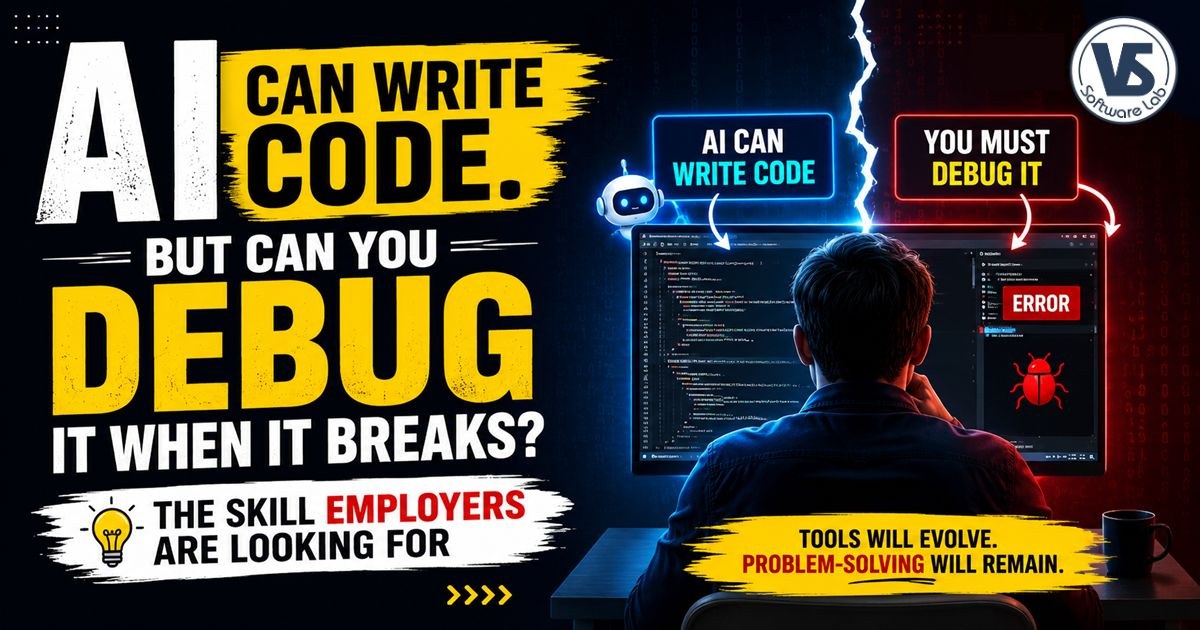
AI Can Write Code. But Can You Debug It When It Breaks? The Skill Employers Are Looking For
AI can write code, generate scripts, and suggest fixes, but developers still need to understand why things break. Learn why debugging, critical thinking, and problem-solving are becoming essential skills for developers in the age of AI.
AI can write code. It can generate a script in seconds, suggest a fix for an error, and even explain what a piece of code is supposed to do. That is changing the way developers work—and it is also changing what companies look for when they hire them.
For years, technical interviews have often focused on a simple question: Can you write this code?
But as AI coding tools become part of everyday development, another question is becoming far more important:
What would you do when the code breaks?
That is where things get interesting. Writing a function is one thing. Finding out why it fails in a real application is something else entirely.
Was the problem caused by incorrect data? A flaky test? A race condition? An API that suddenly stopped responding? A synchronization issue between two services? Or is there an actual bug in the product?
AI can help investigate these problems, but the developer still needs to understand what is happening, ask the right questions, and decide what to do next.
AI Can Write Code. Debugging Is a Different Skill.
There is a big difference between generating code and understanding a problem.
Imagine an application that suddenly starts returning incorrect results. An AI tool might suggest several possible fixes within seconds. One suggestion may look convincing enough to try immediately. But before changing the code, someone still has to figure out what actually went wrong.
Maybe the input data changed. Maybe an API is returning an unexpected response. Perhaps a recent update introduced a regression. The code itself might be perfectly fine, while the problem is somewhere else in the system.
This is where debugging becomes more than just fixing errors.
A good developer does not simply keep changing lines of code until the error disappears. They investigate. They reproduce the problem, examine logs, check assumptions, isolate the cause, and test possible solutions. Most importantly, they try to understand why the problem happened in the first place.
That kind of thinking is difficult to replace with a tool because every real-world application has its own context. The same error message can have completely different causes depending on the data, environment, architecture, and dependencies involved.
AI can make the process faster. But the ability to reason through an unfamiliar problem is still the developer's responsibility.
When Something Breaks, the Error Message Is Only the Beginning
In real software projects, the hardest part of debugging is often not finding an error message. It is figuring out what that message actually means.
A failed test does not always mean the application code is wrong. A slow API response does not necessarily mean the server is down. An incorrect result could come from bad input data, a database query, a third-party service, or a small change made somewhere else in the system.
This is why experienced developers do not jump straight into fixing the first thing that looks suspicious.
They ask questions.
- Can the problem be reproduced consistently?
- Did anything change before the issue appeared?
- Is the problem happening for every user or only in specific cases?
- Are the tests failing because of a real bug or because the test itself is unreliable?
- Is an external API returning unexpected data?
- Could timing or synchronization be causing the issue?
The answers help narrow down the real cause. Sometimes the fix is a single line of code. Sometimes the problem is not in the code at all.
That ability to investigate before making changes is becoming increasingly valuable. AI can suggest possibilities, but a developer still needs to separate a useful suggestion from a misleading one.
AI Makes Developers Faster, but It Does Not Remove the Need to Think
There is no doubt that AI is making software development faster.
A developer can use AI to generate boilerplate code, explain an unfamiliar function, write test cases, suggest improvements, or explore different approaches to a problem. Tasks that once took considerable time can now be completed much more quickly.
That is a real advantage. But speed is not the same as understanding.
If a developer accepts every AI-generated suggestion without checking it, a small mistake can easily become a bigger problem. The code may look clean and work in one situation while failing somewhere else. It may also introduce a security issue, create unexpected behaviour, or solve the wrong problem entirely.
The developer still has to make the final decision.
That means understanding the requirements, questioning assumptions, checking the results, and knowing when a suggested solution does not make sense. AI can provide an answer, but developers need enough technical understanding to judge whether that answer is actually correct.
In many ways, AI is changing the developer's role from simply writing more code to making better decisions about the code being written.
The Developers Who Stand Out Will Be the Ones Who Can Investigate
As AI becomes better at generating code, basic coding tasks may become less useful as the only measure of a developer's ability.
Employers will still need people who can build software, of course. But they will also need developers who can step into an unfamiliar codebase, understand what is happening, and work through a problem without needing every answer handed to them.
That could mean tracing a bug across multiple files, comparing logs, checking database records, examining an API response, or discovering that a problem reported by a user cannot actually be reproduced in the development environment.
These situations rarely have a neat, one-line answer.
The developer has to form a hypothesis, test it, learn from the results, and keep going when the first explanation turns out to be wrong. That process requires curiosity and patience as much as technical knowledge.
It also requires the ability to explain decisions clearly. In a team, it is not enough to say, “I changed this and now it works.” A strong developer should be able to explain what caused the problem, why the chosen solution addresses it, and what risks or trade-offs were considered.
That combination of technical knowledge, investigation, and clear reasoning is difficult to replace—and it is likely to become even more valuable as AI tools continue to improve.
So, What Should Developers Focus on Now?
The answer is not to stop learning how to code. Programming fundamentals still matter, and they provide the foundation for everything else a developer does.
But developers should go beyond syntax and focus on the skills that help them handle situations where there is no obvious answer.
Learn how to read unfamiliar code. Get comfortable working with logs and debugging tools. Understand how APIs, databases, networks, and different parts of an application interact. Practice finding the root cause of a problem instead of simply treating the visible symptom.
Most importantly, learn to ask better questions.
When something fails, do not immediately ask, “How do I fix this?” Start by asking, “Why did this happen?”
That small change in mindset can make a significant difference. It encourages you to investigate the problem before reaching for a solution—and it also helps you use AI tools more effectively. Instead of blindly accepting an AI-generated fix, you can challenge it, test it, and decide whether it actually solves the underlying issue.
The developers who build these habits today will be better prepared for a future where AI is not just a coding assistant, but a normal part of the software development process.
The Future Belongs to Developers Who Can Think
Technology will continue to change. The tools developers use today may look completely different a few years from now.
AI will become better at writing code. It will become better at finding patterns, suggesting solutions, and helping developers move from an idea to a working application faster than ever.
But when a system behaves unexpectedly, someone still needs to understand the situation.
Someone needs to ask the right questions, investigate the evidence, challenge assumptions, and decide which solution makes the most sense. Someone needs to explain that decision to the rest of the team.
That is why the most valuable skill in the age of AI may not be knowing every programming language or memorizing every syntax rule. It may be the ability to think clearly when the answer is not obvious.
Tools will evolve. Programming languages will change. AI assistants will become more capable.
But the ability to understand a problem, find its root cause, and solve it thoughtfully will remain valuable.
So perhaps the next time you prepare for a developer interview, do not only practice questions that ask you to write code.
Practice explaining what you would do when that code fails.
Because writing code is becoming easier. Knowing what to do when it breaks is where the real skill shows.
What Skill Will Matter Most in the Age of AI?
There is no single answer to this question. The skills that matter will depend on the role, the technology, and the kind of problems a developer is expected to solve.
But one thing is becoming clear: knowing how to use AI is only part of the equation.
The developers who can combine AI tools with strong fundamentals, critical thinking, debugging ability, and practical problem-solving will have a real advantage. They will know when to trust an AI suggestion, when to question it, and when to take a completely different approach.
AI may help us write code faster. The real value comes from knowing what to build, understanding when something goes wrong, and making sound decisions when there is no obvious solution.
What skill do you think will matter most for developers in the age of AI?
Is it debugging? Problem-solving? System design? Communication? Or something else?
Share your thoughts. The conversation about what makes a great developer is only getting started.
Final Thought
AI is not making programming irrelevant. It is changing where a developer's value comes from.
When code can be generated in seconds, the ability to understand that code becomes more important. When an AI tool can suggest ten possible fixes, knowing how to identify the right one becomes a valuable skill. And when something goes wrong in production, the ability to calmly investigate the problem can matter more than how quickly someone can write a new function.
The future of software development will likely belong to people who know how to work with AI without becoming dependent on it.
Learn the tools. Use them. Let them make you faster.
But keep building the skills that help you think, question, investigate, and solve problems.
Because tools will keep evolving. Problem-solving will remain valuable.
Frequently Asked Questions
Will AI replace software developers?
AI is unlikely to eliminate the need for skilled software developers, but it is changing the way they work. Developers who can understand systems, debug problems, make decisions, and solve complex issues will continue to be valuable as AI becomes more capable.
Why is debugging becoming more important for developers?
AI can generate code quickly, but generated code can still contain errors or fail in unexpected situations. Developers need to understand why something went wrong, identify the root cause, and choose the right solution. That makes debugging an increasingly important skill.
Is coding still an important skill in the age of AI?
Yes. Strong programming fundamentals remain important because developers need to understand, review, test, and maintain the code produced by themselves or AI tools. Knowing how code works also makes it easier to identify incorrect or unreliable solutions.
What skills should developers learn alongside AI tools?
Developers should focus on problem-solving, debugging, critical thinking, system design, communication, and understanding software architecture. Learning how to use AI tools effectively is also valuable, but it should complement—not replace—technical knowledge.
What is more important: coding or problem-solving?
Both are important, but problem-solving becomes especially valuable when working on real-world software. Writing code is only one part of development. Understanding requirements, identifying the cause of failures, evaluating solutions, and making sound technical decisions are equally important.
How can students prepare for AI-focused developer interviews?
Students should practice coding fundamentals while also learning how to debug real problems. Instead of only solving programming questions, they should practice reading existing code, analyzing errors, investigating unexpected results, and explaining why they chose a particular solution.
Conclusion
AI is changing software development, but it is also changing the skills that companies value in developers.
The ability to write code will remain important. However, developers who can investigate problems, understand the root cause of failures, question AI-generated solutions, and explain their technical decisions will have an advantage.
So, while preparing for your next interview or planning your career, do not focus only on how quickly you can write code. Learn to understand what happens when the code does not work as expected.
Because the future may not belong to the developer who writes the most code. It may belong to the developer who knows what to do when the code breaks.
Ready to Build Skills That Employers Value?
Learning to code is only the beginning. Real-world experience helps you develop problem-solving, debugging, communication, and practical skills that can make a difference in your career.
Not sure whether an internship or training is right for you? Read our guide to understand the difference and choose the path that fits your career goals.
Read: Internship vs Training: What’s the Difference and Which One Should You Choose?
Also Read: Final Year Projects: Ideas, Guidance, and Resources for Students