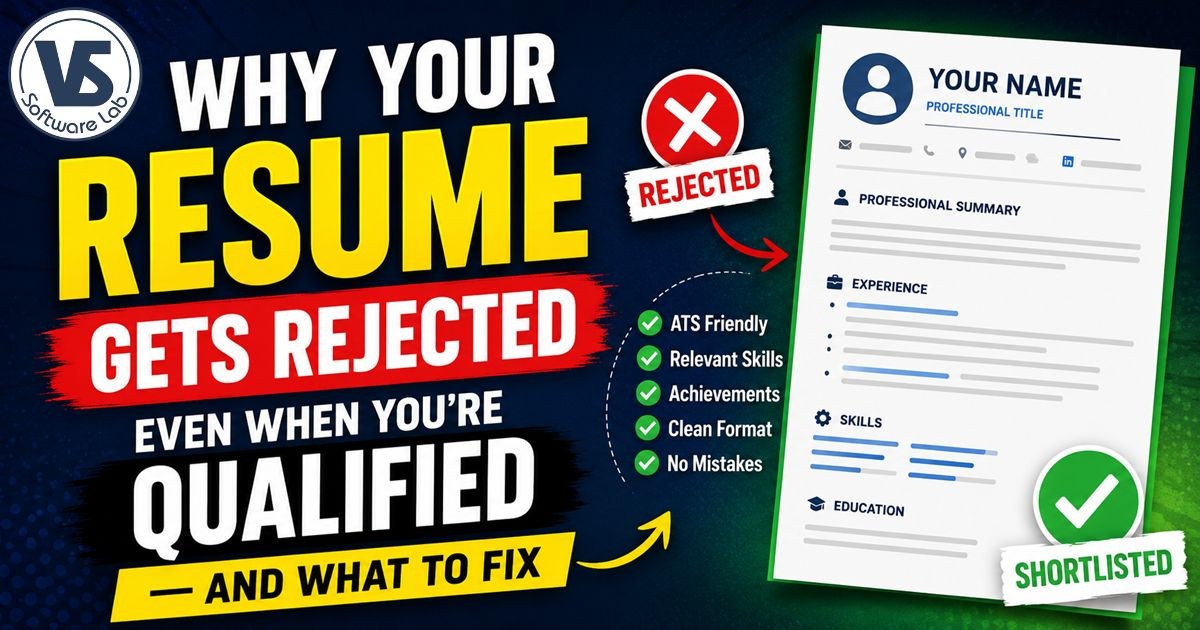
Why Your Resume Gets Rejected Even When You’re Qualified—and What to Fix
You may have the right skills, but your resume could be holding you back. Learn how to improve your resume with ATS-friendly formatting, relevant skills, measurable achievements, tailored content, and simple changes that can help you get shortlisted.
Why Your Resume Gets Rejected Even When You’re Qualified—and What to Fix
You have the skills. You have the qualifications. You may even have the experience the company is looking for. Yet, after sending dozens of applications, your inbox is still quiet.
It is frustrating—and sometimes it feels unfair. You see people with less experience getting shortlisted while your application never seems to make it past the first stage.
But there is something many job seekers overlook: being qualified for a job and presenting yourself as the right candidate are two different things.
Your resume is often the first impression a recruiter gets of you. Before they speak to you, they use that document to quickly understand who you are, what you can do, and whether your background matches the role.
That means even a strong candidate can be overlooked because of a resume that is too generic, difficult to read, filled with irrelevant information, or focused more on responsibilities than actual results.
The good news? You do not always need to completely rewrite your resume. Sometimes, a few thoughtful changes can make a significant difference.
Before you apply for your next job, take a few minutes to look at your resume from a recruiter's perspective. Ask yourself one simple question:
“Does this resume clearly show why I am a good fit for this specific role?”
If the answer is not an immediate yes, it may be time to make some changes.
1. Start With a Professional Summary That Says Something Useful
Recruiters do not need another resume that begins with “Seeking a challenging position in a reputed organization where I can utilize my skills and grow professionally.”
It sounds professional, but it tells them almost nothing about you.
Your professional summary should quickly answer three questions: Who are you? What can you do? What kind of role are you looking for?
Keep it short, specific, and relevant to the job you want. Mention your area of expertise, your strongest skills, and the value you can bring to the role.
For example, instead of writing:
“Seeking a challenging position in a growth-oriented organization where I can utilize my skills and knowledge.”
Try something more specific:
“Data Analyst with hands-on experience in SQL, Excel, and Power BI, skilled at cleaning data, building dashboards, and turning complex information into clear business insights.”
The second version immediately gives the recruiter a reason to keep reading. It tells them what you do, what tools you know, and where your strengths lie.
One important point: your summary should change when the job changes. If you are applying for a Data Analyst position, highlight your analytical skills. If you are applying for a Python Developer role, focus on your programming experience and relevant projects.
Think of your professional summary as the opening line of your career story. It should make the recruiter curious about the rest of your resume—not make them work to figure out what you actually do.
2. Show Your Achievements, Not Just Your Responsibilities
One of the most common resume mistakes is turning every job into a list of duties.
“Responsible for managing reports.”
“Worked on data cleaning.”
“Handled customer queries.”
“Developed web applications.”
These statements describe what you were expected to do. They do not show how well you did it or what difference your work made.
A stronger resume focuses on results, improvements, and measurable contributions wherever possible.
For example, instead of writing:
“Cleaned and prepared data for reporting.”
You could write:
“Cleaned and prepared 50,000+ data records using Python, helping improve reporting accuracy and reduce manual data preparation time.”
The second version gives the recruiter more context. It shows the scale of your work, the skill you used, and the impact of your contribution.
You do not need impressive numbers for every bullet point. Not every achievement can be measured in percentages or revenue. You can also highlight improvements you made, problems you solved, processes you simplified, projects you completed, or positive outcomes you helped create.
Before adding a bullet point to your resume, ask yourself:
- What did I actually accomplish?
- What problem did I solve?
- Did my work save time, reduce errors, improve efficiency, or increase results?
- Can I support this achievement with a number, scale, or specific outcome?
Your resume should not simply tell recruiters what your job was. It should help them understand what you achieved while doing it.
3. Match Your Skills to the Job You’re Actually Applying For
There is no prize for putting every skill you have ever learned on your resume.
If a job description asks for SQL, Excel, and Power BI, the recruiter wants to quickly see whether you have those skills. If your resume buries them under a long list of unrelated technologies, tools, and beginner-level skills, your strongest qualifications may be easy to miss.
This is why you should avoid sending exactly the same resume for every job application.
Before applying, read the job description carefully. Look for the skills, tools, qualifications, and experience the employer has specifically mentioned. Then review your resume and make sure your relevant experience is clearly visible.
For example, imagine a company is hiring a junior data analyst and mentions Excel, SQL, data visualization, and reporting as key requirements. If you have worked with these tools, make sure they appear naturally in your professional summary, skills section, projects, or experience—wherever they genuinely belong.
At the same time, do not add a skill simply because it appears in the job description. If you have never used a particular tool or technology, claiming that you know it can create problems later during an interview or technical assessment.
The goal is not to create a different version of your career for every application. It is to present the most relevant parts of your real experience for the specific opportunity.
A good resume answers an important question quickly:
“Why should this recruiter consider this candidate for this particular job?”
If your resume makes that answer obvious, you are already giving yourself a better chance of moving to the next stage.
4. Keep Your Resume Clean, Simple, and ATS-Friendly
A beautiful resume is not necessarily an effective resume.
Many candidates spend hours choosing fancy fonts, adding graphics, icons, progress bars, multiple colors, and creative layouts. While these designs may look impressive to a person, they can sometimes make your resume harder for both recruiters and applicant tracking systems (ATS) to process.
When you apply online, your resume may first be scanned by an ATS that looks for relevant information such as job titles, skills, qualifications, and keywords. If the content is hidden inside complicated design elements or the document is difficult to parse, important information may not be recognized correctly.
That is why a simple, professional layout is usually the safer choice.
- Use clear section headings such as Professional Summary, Skills, Experience, Education, and Projects.
- Choose a clean and readable font.
- Keep your formatting consistent throughout the document.
- Use bullet points to make important information easy to scan.
- Avoid unnecessary graphics, charts, tables, and decorative elements.
- Keep enough white space so the page does not feel crowded.
- Save your resume in the file format requested by the employer.
Most importantly, make sure your resume is easy to read. A recruiter should not have to search through a complicated layout to find your experience or skills.
Your resume is a professional document, not a design competition. The best format is the one that helps recruiters quickly understand your background and see why you are relevant to the role.
5. Stop Using the Same Resume for Every Job
Sending the same resume to every company may save you a few minutes, but it can also reduce your chances of getting noticed.
Different employers are looking for different things—even when the job titles are similar. A Software Developer role at one company may focus heavily on Django and APIs, while another may be more interested in JavaScript, React, and frontend development.
Your experience has not changed. But the way you present that experience should reflect the opportunity you are applying for.
Start by reading the job description carefully. Identify the most important requirements and then review your resume.
Ask yourself:
- Are the most relevant skills easy to find?
- Does my professional summary match the role?
- Have I highlighted projects that are relevant to this position?
- Am I using terminology that accurately reflects the job description?
- Is irrelevant information taking up valuable space?
For example, if you are applying for a Data Analyst position and have completed three projects, you do not necessarily need to give all three projects equal space. Give more attention to the projects that demonstrate skills relevant to data analysis, such as SQL, Excel, Python, Power BI, or data visualization.
This does not mean stuffing your resume with keywords or copying phrases from the job description. It means making your genuine experience easier to connect with what the employer needs.
Think of your resume as a focused application, not a complete record of everything you have ever done.
The more clearly your resume connects your experience with the requirements of the role, the easier it becomes for a recruiter to see you as a potential fit.
6. Keep Your Resume Short, but Do Not Leave Out What Matters
One question that comes up often is: How long should a resume be?
The answer is not simply “one page.” Your resume should be as long as it needs to be to communicate your relevant experience clearly—and no longer.
For many students, freshers, and early-career professionals, a well-written one-page resume is often enough. For experienced professionals with years of relevant work, major projects, leadership responsibilities, or specialized expertise, two pages may make more sense.
The problem begins when candidates add information simply to make their resume look more impressive.
More pages do not automatically mean more experience. A five-page resume filled with repetitive responsibilities can be much weaker than a focused two-page resume that clearly presents relevant achievements.
When reviewing your resume, give priority to:
- Relevant work experience that connects to the position.
- Measurable achievements that demonstrate your impact.
- Technical and professional skills required for the role.
- Certifications that add value to your application.
- Projects that prove you can apply your knowledge in practice.
- Education and qualifications that are relevant to your career stage.
At the same time, remove outdated information, repeated points, irrelevant skills, and details that do not strengthen your application.
Remember, your resume is not judged by its length. It is judged by its relevance.
A shorter resume does not mean you have less to offer. It often means you understand what matters most for the role and know how to communicate it clearly.
7. Add Projects That Prove You Can Apply What You Know
For freshers and students, the projects section can be one of the most valuable parts of a resume.
You may not have years of professional experience yet, and that is completely normal. But you can still show recruiters that you know how to use your skills in a practical situation.
Instead of simply writing:
“Student Management System – Python, Django, SQLite”
Give the recruiter a little more context. Explain what you built, what problem it solved, and what you personally worked on.
“Developed a web-based Student Management System using Python, Django, and SQLite to manage student records, attendance, and academic information. Implemented CRUD operations and a responsive interface for easier data management.”
That small difference changes how your project is perceived. The first version shows that you know some technologies. The second shows that you have actually used those technologies to build something.
When adding projects to your resume, focus on work that is relevant to the role you want. A Data Analyst applicant might highlight a dashboard or data analysis project, while a Python Developer could focus on applications, APIs, automation tools, or backend projects.
You can also mention:
- The technologies and tools you used.
- The problem your project was designed to solve.
- Your specific contribution.
- Important features you implemented.
- Results, improvements, or measurable outcomes when available.
Even a personal project can strengthen your resume when it demonstrates genuine skills and practical thinking.
Do not treat projects as filler to make your resume look longer. Use them as evidence that you can take what you have learned and turn it into something useful.
8. Proofread Your Resume Before You Hit Apply
You can have the right qualifications, relevant experience, and an impressive set of skills—but a few careless mistakes can still hurt your chances.
A spelling mistake in your name, an incorrect email address, inconsistent dates, or a simple grammatical error can make your resume look rushed and unprofessional.
Before submitting your application, take a few minutes to read your resume from beginning to end. Do not just rely on spell-check. Read every section carefully.
Check for:
- Spelling and grammar mistakes.
- Incorrect phone numbers or email addresses.
- Inconsistent formatting and font sizes.
- Wrong employment or education dates.
- Broken links to your portfolio, LinkedIn profile, or projects.
- Unnecessary repetition.
- Extra spaces, missing punctuation, or awkward sentences.
It can also help to ask someone else to review your resume. When you have been looking at the same document for a long time, it is surprisingly easy to miss mistakes that another person notices immediately.
One more useful habit is to read your resume as if you were the recruiter. If you had only a few seconds to review it, would you immediately understand what the candidate does, what skills they bring, and why they are relevant to the role?
If the answer is unclear, go back and simplify it.
Your resume does not need to be perfect in a decorative sense. But it should be accurate, clear, professional, and free from avoidable mistakes.
9. Use Your Resume to Sell Your Value, Not Just Tell Your Story
Your resume is not supposed to document every step of your life. Its job is much simpler: show the employer why your experience, skills, and background make you worth considering.
Think about it from a recruiter's perspective. They are not looking for the person who has the longest resume or the biggest list of skills. They are looking for someone who appears capable of handling the work they need to get done.
That is why strong resumes focus on evidence.
Instead of simply saying that you are a “hardworking team player” or a “quick learner,” show it through your experience. Mention the project you completed, the problem you solved, the process you improved, or the result you achieved.
Instead of writing:
“Excellent communication and leadership skills.”
Show the evidence:
“Led a four-member student team to develop and present a final-year project, coordinating tasks and delivering the project within the scheduled deadline.”
The second statement gives the reader something concrete to evaluate.
This approach applies to almost every part of your resume. Whenever you make a claim about yourself, ask whether you can support it with an example, achievement, project, or outcome.
Your resume should make the recruiter think:
“This person has done something similar before. They could potentially do it here too.”
That is the difference between a resume that simply describes a candidate and one that makes a convincing case for them.
10. Use the Final 10 Minutes Before Applying Wisely
You do not always need to spend hours rewriting your resume before every application. Sometimes, the most valuable improvements can be made in the final few minutes before you click “Apply.”
Take a quick look at the job description one more time. Then compare it with your resume.
Check whether your professional summary reflects the role. Make sure your most relevant skills are easy to find. Review your experience and projects to see whether the strongest and most relevant points are clearly visible.
Then ask yourself five simple questions:
- Is it clear what I do?
- Are my most relevant skills easy to find?
- Have I shown achievements instead of only listing responsibilities?
- Is the resume clean, readable, and ATS-friendly?
- Have I checked it for mistakes before sending it?
If you can confidently answer yes to all five, you are in a much better position to submit your application.
These small checks may take only a few minutes, but they can prevent simple mistakes from weakening an otherwise strong application.
Before you send your next resume, pause for 10 minutes. Read it once more. Make the changes that matter. Then apply with confidence.
What a Strong Resume Really Looks Like
There is no single perfect resume that works for every person or every job. A resume that works for a recent graduate will look different from one created for a senior professional with ten years of experience.
But the strongest resumes usually have one thing in common: they make the recruiter's job easier.
Within a short review, the recruiter should be able to understand who you are, what you are good at, what you have achieved, and how your background connects to the position.
A strong resume is usually:
- Relevant: It focuses on information that matters for the role.
- Specific: It uses real examples instead of vague claims.
- Achievement-focused: It highlights outcomes and contributions, not just responsibilities.
- Easy to scan: Important information is clearly organized and simple to find.
- ATS-friendly: The content and formatting are structured in a way that is easy for recruitment systems to process.
- Accurate: It contains no avoidable spelling, grammar, formatting, or factual errors.
- Tailored: It reflects the requirements of the specific job being targeted.
Most importantly, a strong resume does not try to impress everyone. It is designed to connect with the right employer for the right opportunity.
That is the mindset you should have when reviewing your own resume. Do not ask, “How can I make my resume look more impressive?”
Ask instead:
“How can I make it easier for the right recruiter to see my value?”
That simple change in perspective can completely change the way you write and improve your resume.
Final Thoughts: Your Resume Should Open the Door, Not Tell Your Whole Story
Getting rejected from a job does not always mean you lack the skills to do it. Sometimes, the problem is simply that your resume failed to communicate your value clearly enough.
Your resume has a limited job to do. It needs to get the recruiter's attention, make your experience easy to understand, and give them enough reason to invite you for the next conversation.
That is why small improvements can matter.
Replace generic statements with specific information. Show achievements instead of only listing responsibilities. Highlight skills that actually matter for the role. Tailor your resume instead of sending the same version everywhere. Keep the formatting clean and ATS-friendly. And before you submit it, take a few minutes to read everything once more.
You do not need to create a resume that impresses everyone.
You need to create one that makes the right recruiter think, “This candidate could be a good fit for us.”
So, before you send your next job application, give your resume one final review. Those extra 10 minutes might be the difference between another application that gets ignored and an opportunity to move forward.
Your skills may already be good enough. Make sure your resume shows it.
Resume Checklist: Check These Before You Apply
Before sending your resume to a recruiter or uploading it to a job portal, take a final minute to run through this checklist.
- ☐ Your professional summary is clear and relevant to the role.
- ☐ Your resume highlights achievements, not just job responsibilities.
- ☐ Your skills match the requirements of the position you are applying for.
- ☐ Your most relevant projects and experience are easy to find.
- ☐ Your resume uses a clean, professional, and ATS-friendly format.
- ☐ Your content is concise and does not contain unnecessary information.
- ☐ Your contact details are correct and up to date.
- ☐ Your education, employment dates, and other important details are accurate.
- ☐ Your spelling and grammar have been checked carefully.
- ☐ Your LinkedIn, portfolio, GitHub, or other relevant links work correctly.
- ☐ You have tailored the resume for the specific job.
- ☐ You have reviewed the final version before clicking “Apply.”
A resume does not need to be complicated to be effective. It needs to be relevant, clear, accurate, and focused on the value you can bring to the role.
Take those extra 10 minutes. Read it like a recruiter would. If the most important information is easy to find and your resume clearly explains why you are a good fit, you are ready to apply.
Ready to Improve Your Resume?
If you have been applying for jobs without getting the response you expected, your skills may not be the only thing you need to reconsider. Your resume could be the first place to start.
Instead of sending the same resume to every employer, take a few minutes to improve it for the role you actually want. Remove information that does not add value, highlight your strongest achievements, and make sure your most relevant skills are easy to spot.
If you are a student or fresher, do not worry if you do not have years of work experience. Your projects, internships, certifications, technical skills, and practical work can still show recruiters what you are capable of.
And if you are an experienced professional, remember that your resume does not need to include everything you have ever done. Focus on the experience and achievements that matter most for your next career move.
A better resume starts with better decisions about what you choose to include.
Review yours today. Make the right changes. Then apply with a resume that gives recruiters a clear reason to consider you.
Frequently Asked Questions About Resumes
How long should a resume be?
For most freshers and early-career professionals, one page is usually enough to present relevant skills, education, projects, internships, and experience. Experienced professionals may need two pages to properly cover their relevant achievements and career history. The focus should always be on relevance rather than length.
Should I use the same resume for every job?
No. Your main career information can remain the same, but you should tailor your resume to each position. Highlight the skills, projects, and experience that are most relevant to the specific job description.
What makes a resume ATS-friendly?
An ATS-friendly resume generally uses a clean and simple structure with clear headings, readable formatting, standard section names, and relevant keywords that accurately reflect your skills and experience. Avoid overly complicated layouts or hiding important information inside graphics.
Should freshers include projects on their resumes?
Yes. Projects can be especially valuable for freshers who have limited professional experience. A well-described project can demonstrate your technical skills, problem-solving ability, tools you have used, and your ability to apply what you learned in a practical situation.
Should I include every skill I know?
No. Focus on skills that are relevant to the position you are applying for and that you can confidently discuss during an interview. A shorter list of relevant skills is generally more useful than a long list of unrelated or basic skills.
Is a one-page resume always better?
Not necessarily. A one-page resume is often ideal for students and early-career professionals, but experienced candidates may need more space to present significant achievements and relevant experience. Do not remove valuable information simply to meet an arbitrary page limit.
How can I improve my resume quickly?
Start with the job description. Make sure your professional summary, skills, experience, and projects clearly reflect the requirements of the role. Remove irrelevant information, replace vague statements with specific achievements, check your formatting, and proofread the final version before applying.
Before You Apply for Your Next Job
Take 10 minutes to review your resume.
Make sure it clearly shows who you are, what you can do, and why you are a good fit for the role. Remove what does not matter, improve what does, and proofread everything before you submit your application.
A better resume does not happen by chance. It happens when you make the right changes.