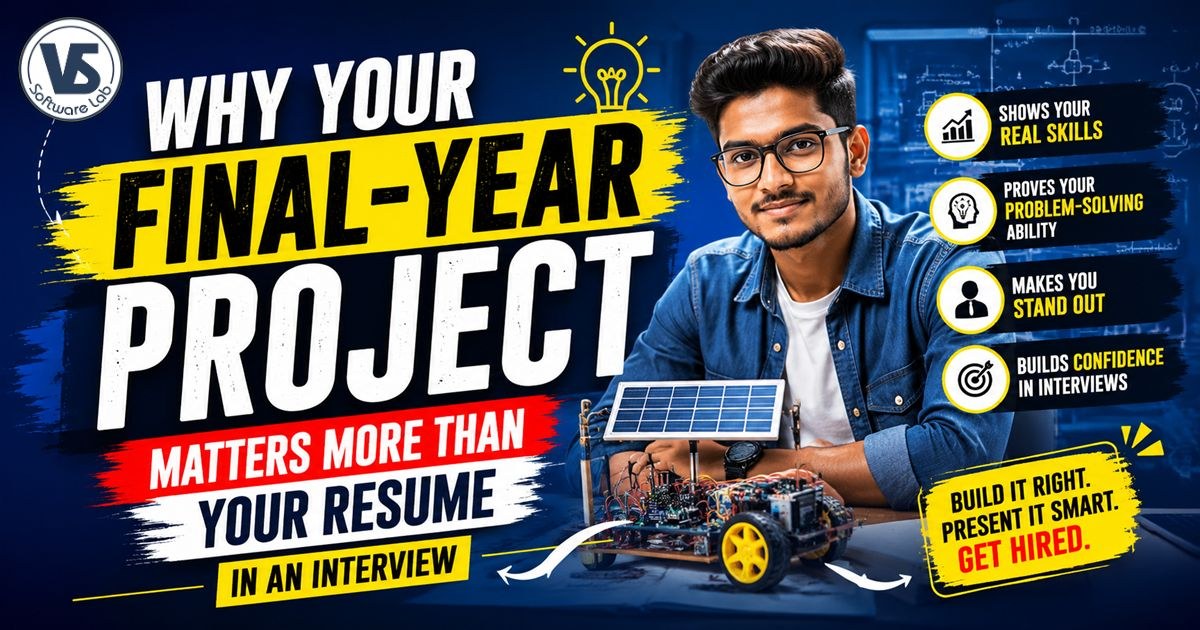
Why Your Final-Year Project Matters More Than Your Resume in an Interview
Your final-year project is more than an academic requirement. Learn why it matters in interviews, how it demonstrates your practical skills, and how to build and present a project that can help you stand out to employers.
A final-year project is often treated as the last academic requirement before graduation. But in reality, it can be much more than that. For engineering students, a well-planned and well-executed project can become one of the strongest ways to demonstrate practical knowledge, technical skills, problem-solving ability, and confidence.
When you sit for a job interview, your resume may tell the interviewer what you have studied and which technologies you have learned. Your final-year project, however, gives you an opportunity to show what you actually did with that knowledge.
This is why interviewers often ask questions such as: What problem did your project solve? Why did you choose this technology? What challenges did you face? and What would you improve if you had more time?
The answers to these questions can reveal much more about your practical skills than a list of technologies on a resume.
In this guide, we will explore why your final-year project matters during interviews, how to approach an engineering project step by step, and how to use your project experience to demonstrate your real capabilities to potential employers.
Why Your Final-Year Project Matters in an Interview
For many engineering students, a final-year project is simply something that needs to be completed before graduation. But for recruiters and interviewers, it can be an opportunity to understand how you think, how you solve problems, and how well you can apply your technical knowledge in a practical situation.
Your resume may list programming languages, frameworks, tools, certifications, and academic achievements. However, a project gives you something more valuable: a real example of how you used those skills.
During an interview, a recruiter may ask you to explain your project from start to finish. They may want to know how you identified the problem, why you selected a particular solution, what technologies you used, what challenges you faced, and how you tested the final result.
These questions are not only about the project itself. They help the interviewer understand your technical knowledge, logical thinking, problem-solving approach, teamwork, communication skills, and ability to learn from mistakes.
This is why your final-year project can become one of the most important topics discussed during a fresher interview. If you have genuinely worked on your project and understand every part of it, you have a valuable opportunity to demonstrate skills that may not be visible from your resume alone.
Your resume tells employers what you know. Your project gives you a chance to show how you use that knowledge.
Start With a Problem, Not Just a Project Idea
One of the biggest mistakes students make is choosing a project simply because it sounds interesting or because someone else has already built it. A strong engineering project should begin with a real problem or genuine need.
The purpose of engineering is to use knowledge and practical skills to create a useful solution. Your project could improve an existing process, solve a specific problem, reduce manual effort, save time, improve efficiency, or make an existing system easier to use.
Before deciding what to build, ask yourself a few simple questions:
- What problem am I trying to solve?
- Who is facing this problem?
- Why does this problem need a solution?
- What are the limitations of existing solutions?
- How can my project improve the current situation?
Once you have a clear understanding of the problem, you can define the goal of your project. This makes the entire development process more focused and helps you explain your project confidently during an interview.
Remember, a good project is not necessarily the one with the most complicated technology. A good project is one that addresses a clear problem and demonstrates your ability to design, develop, test, and improve a practical solution.
Where Can You Find Engineering Project Ideas?
Finding the right project idea can sometimes be challenging. You can get suggestions from your teachers, project advisors, mentors, industry professionals, or even from problems you observe in your daily life.
You can also explore existing systems and identify areas where they can be improved. For example, you might find an opportunity to automate a manual process, improve the user experience of an existing application, make information easier to access, or develop a smarter way to manage data.
The most important thing is to choose a project that you understand and genuinely want to work on. You should be able to explain why you selected the problem, what solution you proposed, and how your project works.
Keep a Project Notebook From Day One
Once you have selected a project idea and defined the problem, your next step should be to start documenting your work. You can maintain a physical notebook, digital document, or project management system where you record important decisions and progress throughout the project.
Do not wait until the final week to prepare your project documentation. Record your work as you progress. This can include your initial ideas, research findings, discussions with mentors, design decisions, challenges, test results, changes, and lessons learned.
A project notebook can help you keep track of:
- The problem you are trying to solve
- The main objective and goals of the project
- Research and background information
- Possible solutions you considered
- Technologies, tools, and components selected
- System designs, diagrams, and architecture
- Development progress and important milestones
- Problems and technical challenges you encountered
- Testing methods and test results
- Changes made after testing
- Ideas for future improvements
Engineering design is rarely a straight line from an idea to a finished product. The process is often iterative. You may build something, test it, discover a problem, make changes, and test it again. This cycle can happen several times before you arrive at a satisfactory solution.
Keeping a record of these iterations can be extremely valuable. It helps you understand how your project evolved and gives you real examples to discuss during interviews. Instead of simply saying, "I developed this project," you can explain the decisions you made, the problems you faced, and how you improved your solution.
Don't document your project only after it is finished. Document the journey while you are building it.
The Engineering Design Process: Step by Step
A successful engineering project usually follows a structured design process. This process helps you move from identifying a problem to developing, testing, and improving a practical solution.
The process is not always linear. In many projects, you may need to return to an earlier step, make changes, and test your solution again. This iterative approach is a normal and important part of engineering.
1. Define the Need and Express It as a Goal
The first step is to clearly identify the problem or need that your project is addressing. A well-defined problem gives your team a clear direction and helps you decide what the final solution should achieve.
Once you understand the problem, convert it into a specific project goal. Your goal should clearly explain what you want to accomplish and what outcome you expect from your project.
2. Establish Design Criteria and Constraints
After defining your goal, determine the requirements your solution must satisfy. These requirements are known as design criteria.
For example, your project may need to be easy to use, affordable, reliable, secure, fast, or energy efficient. You should also identify the constraints that may affect your design, such as budget, available resources, time, technology, hardware, or technical limitations.
Clearly defining your criteria and constraints helps you create a realistic solution rather than designing something that is difficult or impossible to implement.
3. Evaluate Alternative Designs
There is rarely only one possible solution to an engineering problem. Before starting development, explore different approaches and compare their advantages and disadvantages.
Consider factors such as cost, complexity, performance, scalability, reliability, and ease of implementation. Evaluating alternatives allows you to select the approach that best meets your project requirements.
4. Build a Prototype of the Best Design
Once you have selected the most suitable design, it is time to turn your idea into a working prototype. Depending on your engineering discipline, this could be a software application, electronic system, mechanical model, embedded system, or another type of working solution.
The prototype does not always have to be the final version. Its primary purpose is to provide a practical version of your idea that can be tested and evaluated.
5. Test and Evaluate the Prototype
Testing is one of the most important stages of any engineering project. Your prototype should be tested against the design criteria and requirements you established earlier.
Check whether the solution works as expected. Identify errors, limitations, performance issues, usability problems, or unexpected results. Document your test cases and results carefully.
A project that has been properly tested gives you stronger evidence that your solution actually addresses the problem you originally identified.
6. Analyze Results, Make Changes, and Retest
Testing may reveal that your initial design needs improvement. This is completely normal. Analyze the test results and identify what needs to be changed.
Make the necessary improvements and test the solution again. You may need to repeat this cycle several times until your project meets the required criteria.
This iterative process is one of the most valuable parts of engineering because it teaches you how to learn from failures, identify weaknesses, and continuously improve a solution.
7. Communicate the Final Design
The final step is to communicate your project effectively. This includes preparing your project report, presentation, documentation, demonstration, and interview explanation.
You should be able to explain the complete journey of your project—from the original problem and proposed solution to the technologies used, challenges faced, testing performed, and improvements made.
Remember that even a technically strong project can lose its impact if you cannot explain it clearly. Good communication allows others to understand the value of your work and the skills you gained while building it.
What Your Project Says About Your Skills
Your final-year project is not just a demonstration of the technology you used. It is an opportunity to show how you approach real-world problems and work through challenges.
When you explain your project during an interview, recruiters may evaluate several skills without directly asking you to list them. Your project experience can demonstrate:
- Problem-Solving Skills: How you identified a problem and developed a practical solution.
- Technical Knowledge: How well you understand the technologies, tools, frameworks, or components used in your project.
- Logical Thinking: How you analyze problems and make decisions during development.
- Creativity and Innovation: How you developed a new approach or improved an existing solution.
- Teamwork: How you collaborated with team members and divided responsibilities when working on a group project.
- Communication Skills: How clearly you can explain your project, technical decisions, and results.
- Adaptability: How you responded when your original approach did not work as expected.
- Learning Ability: How you learned new technologies or concepts to complete your project.
These skills are difficult to demonstrate through a resume alone. A project gives you real experiences and examples that you can discuss during an interview.
For example, instead of simply writing "Python" or "Django" on your resume, you can explain how you used Python to build a particular feature, why you selected Django, what technical problem you encountered, and how you solved it.
This is what makes a genuine project experience valuable. It gives your technical skills a story, context, and practical evidence.
The strongest project is not the one with the longest list of technologies. It is the one you understand deeply and can confidently explain.
Use Your Academic Project to Your Advantage
Many fresh graduates worry that they do not have enough professional experience when they attend their first job interview. If you are a fresher, your academic project can help bridge that gap.
Your project may not be commercial experience, but it can still demonstrate that you have applied your knowledge to build something practical. The key is to understand your project thoroughly and present it honestly.
During an interview, be prepared to explain your project from beginning to end. Start by explaining the problem you wanted to solve and why you selected it. Then describe your proposed solution, your role in the project, the technologies you used, and how the system works.
You should also be ready to discuss the challenges you faced. Perhaps a feature did not work as expected, your initial approach failed, you faced performance issues, or you had to learn a new technology. Explain what happened, what you did to solve the problem, and what you learned from the experience.
Interviewers do not always expect your academic project to be perfect. In many cases, they are more interested in understanding your thinking process and your ability to learn from challenges.
Be Honest About Your Project
One of the most important rules when discussing your academic project is to be honest. Never claim that you developed something that you did not actually build or understand.
If your interviewer asks a technical question about your project and you cannot explain the answer, it can quickly become clear that you did not work on the project yourself.
Instead, be transparent about your contribution. If you worked as part of a team, clearly explain which features or modules you were responsible for. If you used an existing library, framework, API, or open-source component, understand how it works and be prepared to explain how you integrated it into your project.
Your project should be something you can confidently stand behind. The goal is not to make your project sound bigger than it is. The goal is to demonstrate what you genuinely learned and what you can actually do.
Prepare for Project-Based Interview Questions
Before attending an interview, review your project carefully and prepare for questions such as:
- What problem does your project solve?
- Why did you choose this project?
- What was your role in the project?
- Why did you choose these technologies?
- How does your project work?
- What was the biggest challenge you faced?
- How did you solve a technical problem?
- How did you test your project?
- What would you improve if you had more time?
- What did you learn while working on the project?
Preparing for these questions can help you communicate your experience clearly and confidently. More importantly, it encourages you to think critically about the work you have done instead of simply memorizing a project description.
Common Final-Year Project Mistakes Students Should Avoid
A final-year project can be a valuable learning experience, but only if you genuinely participate in the process. Unfortunately, many students make mistakes that reduce the value of their project and leave them unprepared for project-based interview questions.
1. Choosing a Project Only Because It Looks Impressive
A project does not become valuable simply because it uses advanced technologies or has a complicated title. If you cannot explain how the system works, the technology alone will not help you during an interview.
Choose a project that matches your interests and current skill level while giving you an opportunity to learn something new.
2. Copying an Existing Project Without Understanding It
Using tutorials, documentation, open-source resources, or existing projects for learning is completely normal. The problem begins when you copy a project without understanding the code or the decisions behind it.
If you use existing resources, take the time to understand them, modify the solution where appropriate, and learn why each important component is required.
3. Starting Development Without Defining the Problem
Some students start coding immediately without clearly defining what their project is supposed to solve. This can lead to unnecessary features, unclear objectives, and a project that lacks direction.
Always define the problem, target users, objectives, requirements, and expected outcome before beginning development.
4. Ignoring Testing
Building a project is only part of the engineering process. You also need to test whether your solution works correctly and meets the requirements.
Test your project with different scenarios, identify problems, document the results, and make improvements based on your findings.
5. Leaving Documentation Until the Last Minute
Trying to remember several months of project work just before submission can make documentation difficult and incomplete.
Maintain your project documentation throughout the development process. Record important decisions, changes, challenges, test results, and improvements as they happen.
6. Not Understanding Your Own Project
This is perhaps the biggest mistake a student can make. If you are presenting a project in your resume, you should understand its purpose, architecture, technologies, major features, and your own contribution.
Remember that interviewers may ask questions beyond your project presentation. Be prepared to explain not only what you built, but also why you built it that way.
7. Focusing Only on Completion
Completing a project and submitting it is not the same as learning from it. The real value of an engineering project comes from the skills you develop while researching, designing, building, testing, and improving your solution.
Instead of asking only, "How can I finish my project?", ask yourself, "What skills can I gain from building this project?"
How to Make Your Final-Year Project Interview-Ready
Completing your final-year project is only the first step. If you want your project to help you during job interviews, you should also prepare yourself to explain and demonstrate it clearly.
Understand Every Important Part of Your Project
Start by reviewing your project from beginning to end. Make sure you understand the problem statement, project objectives, system architecture, technologies, database structure, major features, and the role of each important component.
You do not need to memorize every line of code. However, you should understand the key logic and decisions behind the parts you worked on.
Know Your Individual Contribution
If you worked on a team project, clearly identify your own contribution. Interviewers may ask what you personally developed or which part of the project you were responsible for.
Be ready to explain your specific responsibilities, the challenges you faced, and the solutions you implemented. Avoid taking credit for work completed by other team members.
Prepare a Simple Project Explanation
Practice explaining your project in a simple and structured way. A good explanation can follow this sequence:
- Problem: What problem were you trying to solve?
- Solution: What did you build to solve the problem?
- Technology: Which technologies and tools did you use?
- Process: How does your solution work?
- Challenge: What was the most difficult part?
- Solution to the Challenge: How did you solve it?
- Result: What was the outcome of your project?
- Future Scope: What improvements could be made in the future?
This structure can help you explain your project without getting lost in unnecessary technical details.
Be Ready to Demonstrate Your Project
If possible, keep a working version of your project ready for demonstration. Make sure you know how to start the application, access important features, and explain the main workflow.
For software projects, you can also maintain a clean code repository and keep your project documentation organized. For hardware or embedded projects, ensure that your prototype is functional and that you can explain the system components and their purpose.
Connect Your Project to the Job
Finally, think about how your project relates to the position you are applying for. If you are applying for a software development role, highlight your programming, database, debugging, and development experience. If you are applying for a data or AI role, explain how you handled data, selected algorithms, evaluated results, or solved technical challenges.
When you connect your project experience to the job requirements, your project becomes more than an academic achievement. It becomes evidence of your ability to contribute to a professional environment.
Your Final-Year Project Is Your First Proof of Skill
For an engineering student, a final-year project can be much more than a college submission. It can be your first opportunity to demonstrate that you can take an idea, understand a problem, design a solution, and turn that solution into something practical.
Whether you are developing a software application, building an embedded system, designing a mechanical solution, working on an electronics project, or exploring artificial intelligence and data science, the process teaches you how to approach real-world challenges.
Your project also gives you something valuable to talk about when you have limited professional experience. Instead of simply telling an interviewer that you are a quick learner or a good problem solver, you can share a real example of a challenge you faced and explain how you handled it.
That experience can make your interview answers more authentic and convincing.
However, the real value of your project does not come from its title, complexity, or number of features. It comes from the knowledge and experience you gain while working on it.
A simple project that you genuinely understand can be more valuable than a highly complex project that you cannot explain.
Your project is not just something you submit at the end of your degree. It can be the first real evidence of what you are capable of building.
Final Thoughts: Build a Project You Can Be Proud Of
Your final-year project can play an important role in shaping your early career. It gives you an opportunity to move beyond textbooks and classrooms and apply your knowledge to a practical problem.
Start by identifying a meaningful problem. Define a clear goal, understand the requirements, explore possible solutions, build a prototype, test it, learn from the results, and improve your design. Most importantly, document your journey and understand the work you have done.
When you approach your project this way, you are not simply completing an academic requirement. You are developing skills that can help you in your future career.
Remember that your project may become one of the most discussed topics in your first job interview. So, do not choose a project only to fill a page in your resume. Choose one that gives you something valuable to learn and something meaningful to talk about.
Be honest about your contribution. Understand your technology. Learn from your mistakes. Be ready to explain your decisions. And most importantly, be able to demonstrate what you actually built.
At the end of the day, your resume may help you get noticed, but your knowledge and ability to explain your work can help you make a lasting impression.
Build a project that does more than earn you marks. Build one that helps you prove your skills.
Frequently Asked Questions About Final-Year Projects
Why is a final-year project important for engineering students?
A final-year project gives engineering students an opportunity to apply their theoretical knowledge to a practical problem. It can demonstrate technical skills, problem-solving ability, teamwork, and the ability to develop and test a solution.
Do interviewers ask questions about final-year projects?
Yes. Interviewers often ask freshers about their academic projects to understand their practical knowledge and individual contribution. They may ask about the problem, technology, development process, challenges, testing, and future improvements.
What should I include in my final-year project?
A good project should have a clearly defined problem, specific objectives, appropriate technologies, a practical solution, proper testing, and documentation. The project should also demonstrate what you learned during the development process.
Is a complex project better than a simple project?
Not necessarily. A simple project that solves a meaningful problem and is thoroughly understood can be more valuable than a complex project that you cannot explain. Choose a project that matches your skills while giving you opportunities to learn and improve.
How should I explain my project in an interview?
Start by explaining the problem you wanted to solve, followed by your proposed solution, technologies used, your individual contribution, major challenges, how you solved them, and the final result. Keep your explanation clear and be prepared to answer technical questions about your work.
What if I worked on a project as part of a team?
Clearly explain your individual role and contribution. Describe the modules or features you personally worked on and be honest about which parts were handled by other team members. Interviewers value genuine knowledge and transparency.
Can an academic project help me get my first job?
Yes. While an academic project does not replace professional experience, it can help freshers demonstrate practical skills and provide real examples of their technical and problem-solving abilities during interviews.
Ready to Build Your Project?
Don't wait until the final semester to start thinking about your project. Start exploring problems, discussing ideas with mentors, and learning the technologies you may need.
The best time to build practical skills is while you are still a student. Your final-year project can become more than an academic requirement—it can become a valuable part of your learning journey and a strong conversation starter during your first job interview.
Choose a problem. Build a solution. Learn from the process. And create a project that truly represents your skills.
Looking for Final-Year Project Ideas?
Need inspiration for your next engineering or final-year project? Explore project ideas and find a project that matches your interests, skills, and career goals.