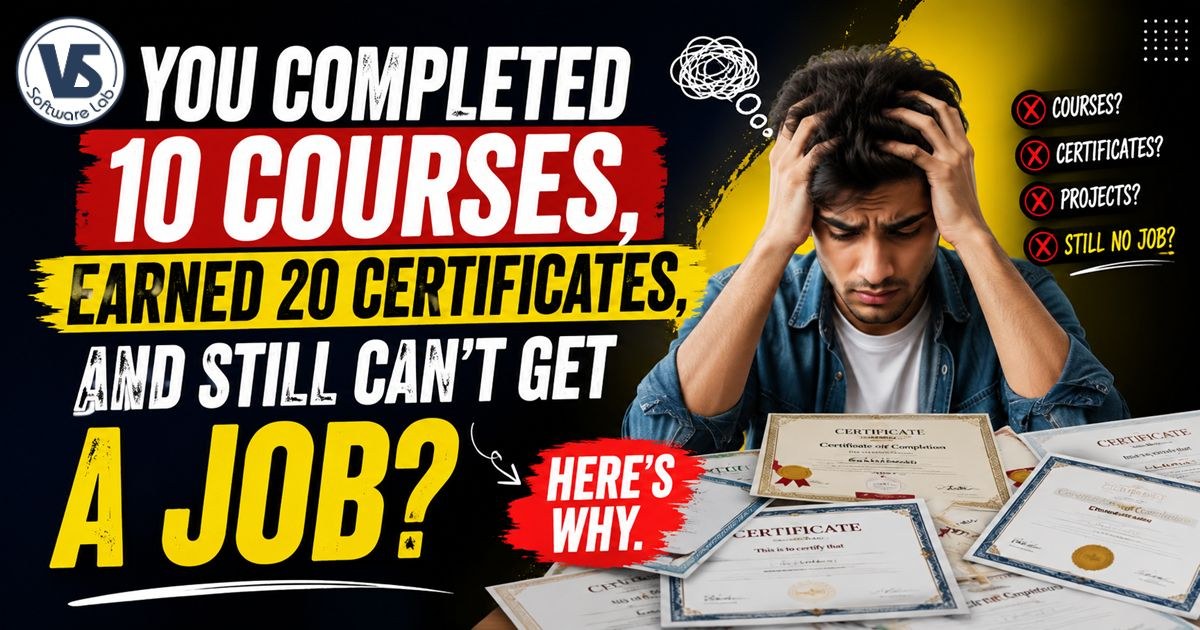
You Completed 10 Courses, Earned 20 Certificates, and Still Can’t Get a Job—Here’s Why
You have completed courses, collected certificates, built a final-year project, and still struggle to get an IT job. This article explores why many students focus on certificates and trends instead of building the practical skills Indian employers actually look for.
You Completed 10 Courses, Earned 20 Certificates, and Still Can’t Get a Job—Here’s Why
There is something I have noticed while talking to students who are preparing to enter the IT industry.
Many of them have a resume filled with courses. Some have completed five courses. Some have ten. Some have even more. Their folders are full of certificates, their LinkedIn profiles are filled with achievement posts, and their final-year project sounds impressive when described in two or three lines.
But then comes a simple question.
“What can you actually do on your own?”
And suddenly, the confidence disappears.
They may have completed a course on a programming language, attended a workshop on a trending technology, completed an online certification, or even worked on a project. But when asked to write a small piece of code without looking at Google, explain how their own project works, find a mistake in their program, or solve a basic logical problem, many students struggle.
This is where the real problem begins.
The problem is not that students are learning too much. Learning is never the problem.
The problem is when collecting certificates becomes more important than developing the ability to do the work.
If you are a student preparing for your first IT job, a final-year student wondering what to learn next, or a recent graduate who has already completed several courses but is still waiting for the right opportunity, this article is for you.
This is not about telling you that your certificates are useless. They are not.
It is about understanding what those certificates are supposed to represent—and what employers actually want to see when you walk into your first interview.
The IT Industry Is Changing. But the Basics Have Not Disappeared.
Every few months, students hear about a new technology that is going to change the future.
One year, everyone is talking about one field. The next year, another technology becomes the new hot topic. Suddenly, students start asking themselves, “Should I learn this too?”
And this is where many students make their first mistake.
Instead of asking, “What am I good at, and what do I genuinely want to become?”, they ask, “What is trending right now?”
There is nothing wrong with learning new technologies. In fact, you should. The IT industry rewards people who keep learning because technology never stands still.
But there is a difference between learning a technology because you understand where it fits in your career and learning it because everyone around you is talking about it.
A student who has strong programming fundamentals can usually move from one technology to another with time and practice. A student who only memorises tools and follows trends may find it difficult when the technology changes.
That is why the basics still matter.
Understanding programming logic. Knowing how variables and conditions work. Being comfortable with loops and functions. Understanding data structures at an appropriate level. Learning how databases work. Knowing how to read an error message. Being able to debug your own code. Understanding how a simple application is designed and built.
These things may not always look exciting on social media.
There may not be a certificate for every small improvement you make in these areas.
But when you sit in front of an interviewer and are asked to solve a problem, explain your project, or write a small program, these are the skills that begin to speak for you.
The technology you learn may change.
Your ability to think, understand, build, test, and solve problems is what stays with you.
Before You Chase the Next Trend, Ask Yourself What You Can Actually Build
I have seen students choose their learning path in a very simple way.
They see a technology becoming popular. They hear that companies are hiring for it. Someone tells them that the salary is good. A course appears in front of them. They enrol, complete the lessons, receive a certificate, and move on to the next course.
After a few months, they have learned a little about many things.
But when it is time to apply for a job, they are still unsure about what they actually want to do.
This is not because they are incapable. In many cases, they simply never stopped to understand themselves.
If you are a student from a software background, start by asking yourself a more practical question:
“If someone gives me a problem today, can I build something useful to solve it?”
Maybe your answer is no. That is completely fine. You are a student. You are still learning.
But then your next step should be to learn the fundamentals and practise until the answer slowly becomes yes.
You do not need to know everything before applying for your first job. No reasonable company should expect a fresher to know everything. But you should have at least one area where you can demonstrate genuine understanding.
If you say you know programming, you should be able to write and understand basic programs.
If you mention a project on your resume, you should know how that project works.
If you say you are interested in software development, you should have tried building something yourself.
If you mention a particular technology, you should be able to explain why you used it and what problem it helped you solve.
That is the difference between learning something and being able to use what you learned.
The goal of your education should not be to reach the end of your course with the longest list of technologies on your resume.
The goal should be to reach the end of your course knowing that you can sit in front of a computer, understand a problem, think about a solution, write code, make mistakes, fix them, and keep going until you find a way forward.
That confidence cannot be printed on a certificate.
You have to build it yourself.
Starting With C or C++ Is Not a Step Backward
There is a common feeling among students today that learning an older programming language means they are falling behind.
They see people talking about the latest technologies and immediately feel that they must start there. If someone tells them to learn the fundamentals of programming first, they may think, “But is that really useful for getting a job?”
Yes. It is.
Whether you begin with C, C++, Java, Python, or another language is not the most important decision you will make. What matters is whether you understand the thinking behind programming.
Can you break a problem into smaller parts?
Can you understand what the program is supposed to do before you start writing it?
Can you use conditions and loops properly?
Can you work with functions?
Can you understand how data moves through a program?
Can you find out why your program is not producing the expected result?
These are not skills that belong to one particular programming language.
A student who genuinely understands programming fundamentals can learn another language later. The syntax may change, but the ability to think logically remains useful.
This is why students should not feel ashamed of starting with the basics.
You do not become a better programmer by rushing toward the most fashionable technology. You become better by understanding what you are doing.
There is also an important difference between knowing the syntax of a language and knowing how to program.
A student may remember how to write a loop because they saw it in a course. But can they decide when a loop is actually needed? Can they use it to solve a new problem they have never seen before?
That is where real learning begins.
So, if you are starting your journey and someone tells you to strengthen your basics first, do not think that you are wasting time.
You are building the foundation on which everything else will stand.
Do not be in such a hurry to learn everything that you forget to learn something properly.
Not Every IT Student Needs to Become an Expert in Everything
Somewhere along the way, students started believing that being employable means knowing everything.
They want to learn programming, web development, mobile apps, artificial intelligence, machine learning, data science, cloud computing, cybersecurity, IoT, and a dozen other things before they graduate.
The intention is understandable. Nobody wants to feel left behind.
But trying to learn everything at once often creates a different problem. You become familiar with many words, but deeply comfortable with very little.
You know what a technology is. You may even know how to describe it in an interview. But when someone asks you to actually use it, you are not confident.
That is not a strong position to start a career from.
As a student, you do not need to know everything. You need to find an area where you can invest enough time to become genuinely capable.
Maybe you enjoy building websites. Then spend time building websites.
Maybe you enjoy solving programming problems. Then strengthen your programming and problem-solving skills.
Maybe you are interested in data. Then learn the fundamentals properly and work with real datasets.
Maybe you enjoy working close to hardware and electronics. Then understand the hardware side instead of choosing a technology simply because it is popular.
There is no shame in choosing a different path from your classmates.
In fact, your career becomes much clearer when you stop comparing your learning journey with everyone else's.
The student who spends six months building three meaningful projects may be in a stronger position than the student who spends the same six months collecting certificates from ten different areas.
The first student may have less to list on a resume, but more to talk about when someone asks, “Show me what you have done.”
That question matters.
Because eventually, your career has to move beyond what you have completed and toward what you are actually capable of doing.
You do not need to be the student who knows everything. Try to become the student who can be trusted to learn, understand, and finish something properly.
Choosing IoT Because It Is Trending Can Become a Problem
One area where this confusion becomes especially visible is when students choose technologies without understanding what they are getting into.
For example, a student with a software background may suddenly decide to take an IoT course because they have heard that IoT has a great future.
There is nothing wrong with learning IoT.
But IoT is not just another software course that you can choose because the topic is trending.
Depending on the project, IoT can involve sensors, microcontrollers, communication protocols, networking, electronics, embedded programming, data processing, and software applications. The exact combination depends on what you are building.
If you come from a pure software background and have never worked with electronics, that does not mean you cannot learn IoT. Of course you can.
But you should first understand what you are choosing.
Do you know what a sensor does?
Do you understand how a device collects information?
Do you know how that information reaches your software?
Can you explain the role of the hardware in your project?
Do you understand what your code is actually controlling or communicating with?
If the answer to these questions is no, there is no need to feel embarrassed. You simply have some fundamentals to learn before you can confidently say that you understand the complete system.
The problem begins when a student completes an IoT course, receives a certificate, and puts an IoT project on the resume without understanding even the basic working of that project.
During an interview, this can become obvious very quickly.
A good interviewer does not need to ask complicated questions. Sometimes, one simple question is enough:
“Can you explain what you personally did in this project?”
If you cannot answer that honestly, the problem is not the technology.
The problem is that you chose something to look impressive instead of choosing something you were genuinely willing to learn and understand.
Trends can tell you what is popular.
They cannot tell you what is right for you.
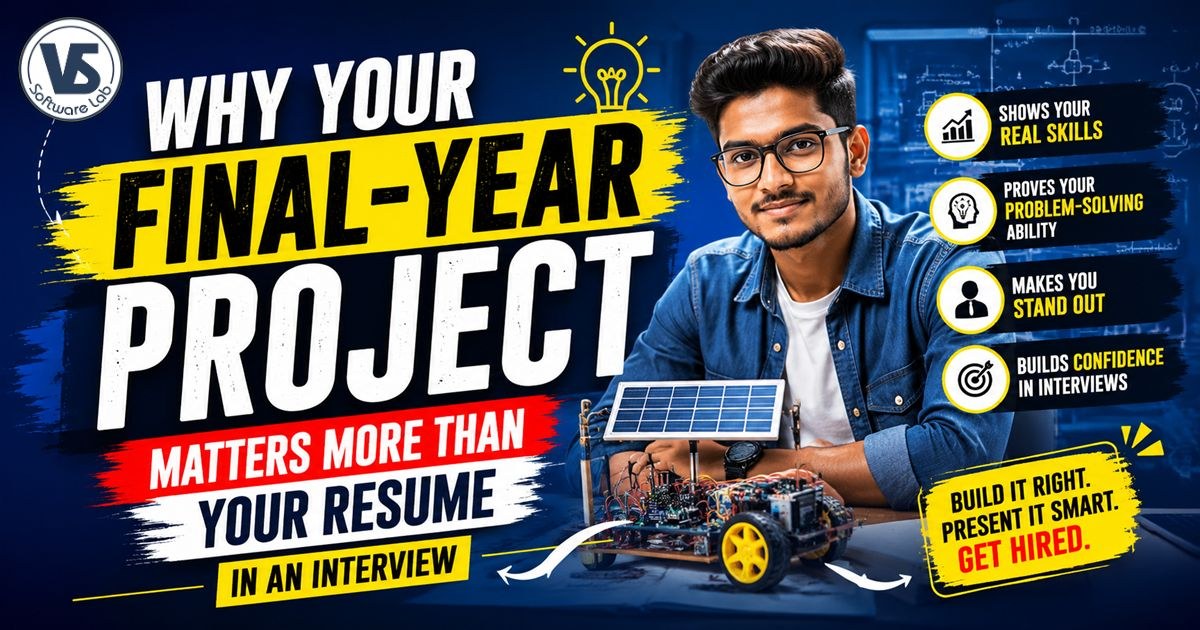
Your Final Year Project Is Not a Decoration for Your Resume
For many students, the final-year project becomes a race.
They want a project that sounds advanced. Something with a complicated title. Something that contains as many technical words as possible. Something that looks impressive when written on a resume.
And sometimes, the most important question gets forgotten.
Do you actually understand what you are building?
A final-year project is supposed to be an opportunity to learn how a real problem is approached. You should understand the problem, think about a solution, decide what technology is appropriate, build the system, make mistakes, test it, and improve it.
It does not have to be the most revolutionary project in the world.
A simple project that you genuinely understand is far more valuable than a complicated project that you cannot explain.
Imagine an interviewer looking at your project and asking you a few basic questions.
Why did you choose this project?
What problem does it solve?
What was your role?
Why did you choose this technology?
How does the system work?
What problems did you face while developing it?
What would you improve if you had more time?
These are reasonable questions.
And if you worked honestly on your project, you should have something to say.
But if your project was selected only because someone told you that it would impress recruiters, or if most of the work was done by someone else, the conversation quickly becomes uncomfortable.
The project may look excellent on paper.
But the moment someone asks you to explain the code, make a small change, or solve a problem related to your own project, the truth becomes visible.
This is why I believe students should choose final-year projects differently.
Do not ask only, “Which project will look impressive?”
Ask, “Which project will force me to learn something useful?”
Choose a problem you can understand. Build it yourself as much as possible. Ask for help when you are stuck, but do not outsource your learning.
Your final-year project should not simply be something you submit to your college.
It should be something that helps you become the kind of person who can walk into an interview and confidently say, “Yes, I built this. I know how it works.”
The Most Dangerous Sentence in an Interview: “This Is My Project, But I Don't Know the Code”
There is something every student should understand before putting a project on a resume.
If you mention a project, be prepared to take ownership of it.
You do not have to write every single line of code completely alone. Real software development does not work that way. Developers use documentation, search for solutions, read existing code, ask questions, use tools, and learn from others.
That is normal.
But there is a big difference between getting help while building something and having no idea how your own project works.
Unfortunately, some students reach their final year with projects they cannot explain. They may have received help from someone else, downloaded code from somewhere, copied a project from the internet, or simply relied on another person to complete most of the work.
Then the project appears proudly on the resume.
During the interview, the student is asked to explain one part of the code.
Silence.
Then comes another question.
Still no clear answer.
At that moment, the problem is not that the student does not know an advanced technology. The problem is that the student has presented someone else's work as evidence of their own ability.
That can hurt your credibility much more than admitting that you are still learning.
If you do not know something, say so.
If you only worked on one part of a project, explain your contribution honestly.
If you used existing code and modified it, understand what you changed and why.
If you took help, learn from that help instead of simply accepting the finished result.
There is absolutely nothing wrong with saying, “I don't know this yet, but I am learning it.”
There is something wrong with claiming knowledge you do not have.
Your first job is not a test of whether you are already a perfect developer. You are a fresher. Employers know that you still have a lot to learn.
What they want to see is whether you are honest, whether you understand what you have written on your resume, whether you can think through a problem, and whether you have the willingness and ability to learn.
Never be afraid of not knowing something. Be afraid of pretending that you know it when you don't.
A Certificate Proves Completion. It Does Not Automatically Prove Capability.
There is nothing wrong with earning certificates.
Certificates can show that you completed a course, attended a training program, or made an effort to learn something new. They can be useful additions to your resume, especially when you are starting your career.
But a certificate has a limit.
It can tell someone that you completed something.
It cannot tell them how well you understood it.
It cannot tell them whether you can solve a problem without being guided at every step.
It cannot tell them whether you can build something on your own.
And it certainly cannot guarantee that you are ready for a job.
This is where students sometimes get trapped in a cycle.
They complete one course and feel they need another. Then another certificate appears. They complete that too. Slowly, the number of certificates keeps increasing, but the confidence to actually work on a real problem does not increase at the same speed.
After some time, the student has a very impressive collection of certificates but still feels nervous when asked to build something from scratch.
That is a sign that it may be time to stop collecting and start practising.
Instead of asking, “Which certificate should I complete next?”, ask yourself:
“What can I build with what I already know?”
Take the knowledge from your last course and use it.
Write your own small program.
Build a simple application.
Work with a real dataset.
Try to solve a problem without following a step-by-step tutorial.
Make a mistake and figure out why it happened.
Then make another mistake.
And fix that one too.
This process may not give you something attractive to post online every week, but it will slowly give you something much more valuable: confidence based on experience.
When you finally sit in an interview, you may not have an answer to every question. That is okay.
But when you are asked about something you have genuinely worked on, you will be able to speak from experience rather than memory.
And there is a big difference between remembering what a course taught you and knowing something because you have actually used it.
Stop Treating LinkedIn Like a Certificate Wall
There is nothing wrong with sharing your achievements.
If you completed a meaningful course, built a project, participated in something valuable, or learned a skill that genuinely helped you grow, you should be proud of it.
But somewhere, the purpose of learning has started getting mixed up with the purpose of posting.
A student completes a short course and immediately posts the certificate.
Then another course.
Another certificate.
Another achievement.
After some time, the profile looks active and impressive. But if someone looks beyond the posts and asks what the student can actually do, there may not be much to show.
This is where you need to be careful.
Do not learn something just because you want something to post.
Learn it because you want to become better.
Do not build a project just because you want to upload a screenshot.
Build it because you want to understand how something works.
Do not collect certificates just because you want your resume to look longer.
Collect knowledge that makes you more capable.
There is a quiet difference between building a career and building an online image of a career.
The first one takes time.
You will spend hours writing code that does not work. You will make mistakes that nobody sees. You will struggle with simple problems. You will sometimes feel that you are not progressing fast enough.
But those difficult moments are often where the real learning happens.
You do not need to announce every step.
Some of the most important progress in your career will happen quietly, when nobody is watching and there is no certificate waiting at the end.
So yes, share your achievements. Be proud of your work.
But remember why you started learning in the first place.
Your goal is not to make people believe that you are skilled. Your goal is to become skilled enough that you no longer need to convince them.
The Indian IT Job Market Does Not Need Another Person Who Only Knows How to Follow a Tutorial
India has a huge number of students entering the technology field every year. That means the competition for entry-level opportunities is real.
When many candidates have similar degrees, similar certificates, and similar resumes, something else starts to matter.
What can you actually do?
Can you take a problem that nobody has explained to you step by step and think about how to solve it?
Can you write code without copying the exact solution from a tutorial?
Can you understand an error instead of immediately asking someone else to fix it?
Can you explain your own project without memorising a presentation?
Can you learn something unfamiliar when your first approach does not work?
These abilities matter because real software work is rarely a perfectly prepared tutorial.
In a real job, someone may give you a requirement that you have never seen before. You may need to understand an existing codebase. You may encounter an error that has no obvious solution. You may have to read documentation, search for information, test different approaches, and sometimes start again.
That is normal.
No fresher is expected to know everything from day one. But a fresher should gradually develop the ability to learn independently and solve problems with patience.
This is also why strong fundamentals continue to matter in the Indian IT market.
The industry may create demand for different technologies at different times. Companies may work on different products and projects. The tools you learn today may not be the same tools you use five years from now.
But the ability to understand a problem, learn a technology, write and read code, debug an issue, communicate clearly, and work responsibly remains valuable.
So, when you prepare for your first job, do not prepare only for the interview.
Prepare for the work that comes after you get selected.
Because getting the job is one milestone. Becoming someone who can genuinely contribute after getting the job is the real beginning of your career.
Your First Job Does Not Require You to Know Everything
There is another misconception that quietly creates a lot of pressure for students.
They believe they need to become an expert before they can apply for their first job.
So they keep waiting.
They complete one more course. Then another. They learn one more technology. Then another. They keep preparing because they feel that they are still not ready.
But the truth is that you will probably never feel completely ready.
Your first job is supposed to be the beginning of your professional learning, not the final exam of your education.
No genuine fresher is expected to walk into a company knowing everything about software development, business processes, teamwork, communication, production systems, or every technology used by the organisation.
You are entering the industry to learn.
What matters is whether you have built enough foundation to start that journey.
You should know the basics of the area you are applying for. You should be able to explain what you have learned. You should have some practical exposure. You should be willing to accept that you do not know everything and still be ready to find the answer.
That last part is important.
A good fresher is not someone who knows everything. A good fresher is someone who knows how to learn.
If you are applying for a software development role, you do not need to know every programming language. But you should be comfortable with at least one language and understand the fundamentals behind it.
If you have built a project, you do not need to claim that it is perfect. But you should know what you built, what you contributed, what went wrong, and what you learned from the experience.
If you do not know the answer to a technical question, do not panic. Think about the problem. Explain your understanding. Be honest about what you do not know. Show the interviewer that you are willing to learn.
There is a big difference between saying, “I don't know, and I don't care to learn,” and saying, “I don't know this yet, but I would like to understand it.”
The first shows a lack of interest.
The second shows potential.
So do not spend your entire final year trying to become an imaginary perfect candidate.
Become a real candidate.
Learn the fundamentals. Build something. Make mistakes. Understand your project. Practise solving problems. Apply for opportunities. Face interviews. Learn from rejection.
You do not need to be completely ready to take your first step. But you should be ready to learn from every step you take.
Before You Choose Your Career, Understand What You Actually Enjoy Doing
One of the biggest mistakes students make is choosing a career only by looking at what is popular.
Someone says there are jobs in a particular field, so you choose it.
Someone says the salary is high, so you choose it.
Your friend joins a course, so you join the same course.
You see people talking about a technology everywhere, so you assume that you must learn it too.
But your career is not a group project.
You are the one who will spend years learning, practising, working, struggling, improving, and eventually becoming good at what you choose.
So before you decide, take some time to understand yourself.
Do you enjoy writing code?
Do you like solving logical problems?
Do you enjoy building websites or applications?
Do you like working with data and finding patterns?
Are you genuinely curious about how hardware and software work together?
Do you enjoy understanding how systems communicate?
Do you like designing things and thinking about how users interact with them?
Or perhaps you discover that you are interested in something completely different.
There is no single correct answer.
The important thing is that your choice should come from some understanding of yourself—not just from fear of missing out.
Of course, the job market matters. You cannot completely ignore demand. You should understand what opportunities exist and what skills companies are looking for.
But there needs to be a balance.
Do not choose a career only because the market is hiring today. Choose a direction where you are willing to keep learning as the market changes.
The technology landscape will continue to change. New tools will appear. Some technologies will become less important. New roles will be created that students today may not even know exist.
If you have developed strong fundamentals and the habit of learning, you will be better prepared for those changes.
So instead of constantly asking, “What is trending?”, start asking a better question:
“What kind of problems do I want to spend my time learning to solve?”
That question may not give you an answer immediately.
But it is a much better place to begin.
Do Not Confuse Being Busy With Actually Moving Forward
There is a difference between being busy and making progress.
A student can spend an entire year attending courses, watching tutorials, completing assignments, collecting certificates, updating a resume, and posting achievements online.
From the outside, it may look like a lot of hard work.
But at the end of that year, one simple question remains:
“What can you do today that you could not do one year ago?”
If the answer is clear, then your effort has probably taken you somewhere.
Maybe you can now build a small application without following a tutorial from beginning to end.
Maybe you can solve programming problems that once seemed difficult.
Maybe you understand databases better.
Maybe you can debug your own code instead of waiting for someone else.
Maybe you have become comfortable reading documentation and figuring things out independently.
That is progress.
But if the only answer is, “I completed five more courses,” then it may be worth asking yourself whether you are actually moving forward.
Learning should change you in some way.
It should make you more capable than you were before.
It should slowly reduce your dependence on step-by-step instructions.
It should make you more comfortable with problems you have never seen before.
It should give you the confidence to say, “I don't know how to do this yet, but I can learn and figure it out.”
That is the kind of confidence you need when you enter the professional world.
So, every few months, stop and honestly evaluate yourself.
Do not count only your certificates.
Count the problems you have solved.
Count the projects you genuinely understand.
Count the mistakes you learned to fix.
Count the times you struggled with something and refused to give up.
Those things may never look as impressive as a long list of certificates.
But they are the experiences that slowly turn a student into a professional.
Your career is not measured by how busy you were. It is measured by how much you grew.
The Resume Should Tell the Truth About You
Your resume is not a place where you have to prove that you know everything.
It is a place where you should clearly show what you have learned, what you have worked on, and what you are capable of doing.
Unfortunately, some students treat their resume like a wish list.
They add every technology they have ever heard of. They mention courses they barely remember. They list projects they did not personally build. They write that they are experts in technologies they have only studied for a few weeks.
Maybe the resume looks impressive for a few minutes.
But the interview eventually catches up with it.
If you write that you know something, be prepared to answer questions about it.
If you mention a project, understand it.
If you list a programming language, be ready to write basic code in it.
If you say you have worked with a particular technology, be honest about the level at which you have worked with it.
You do not have to make yourself look bigger than you are.
There is nothing wrong with writing, “Basic knowledge of...” or “Currently learning...” when that is the truth.
In fact, honesty can make your resume stronger because it creates realistic expectations.
Imagine two students.
The first lists fifteen technologies but struggles to explain most of them.
The second lists five technologies but can confidently discuss how they used each one in their projects.
Which student would you trust more?
The second one.
Because a resume is not a competition to see who can mention the most keywords.
It is a reflection of the person who will eventually sit across from the interviewer.
So before you add another skill to your resume, ask yourself one honest question:
“If someone asks me about this tomorrow, can I defend it with my knowledge?”
If the answer is yes, add it.
If the answer is no, learn it first.
Your resume should open the door to an opportunity.
Once the door opens, your knowledge, attitude, honesty, and ability to learn will determine what happens next.
What Should You Actually Do During Your Final Year?
If you are in your final year right now, you may be feeling a little lost.
You are looking at job descriptions. You are seeing different technologies everywhere. Your friends are taking different courses. Some are preparing for interviews. Some are doing internships. Some are building projects. Others are simply waiting for campus placements.
It is easy to feel that you are already late.
You are not.
But your remaining time is valuable, and you should use it carefully.
Instead of trying to learn everything, choose one direction and give it your honest effort.
Start with the fundamentals of programming. Pick one language and become comfortable writing code in it. Practise logical problem-solving. Learn how databases work. Understand the basics of the field you want to enter.
Then build something.
Not something you found online just to add to your resume.
Build something that makes you think.
Start with a simple idea. Try to build it yourself. When you get stuck, search for the answer. Read documentation. Ask someone who knows more than you. Try again.
That process is far more valuable than simply watching someone else build the same project.
Once you have built something, go back and improve it.
Find the mistakes.
Make the code cleaner.
Add a feature.
Try to understand why your application works the way it does.
Then build another project that is slightly more challenging.
At the same time, start applying for internships and entry-level opportunities. Do not wait until you feel perfect.
You will learn from rejection.
You will discover what interviewers ask.
You will understand where your knowledge is weak.
And then you can go back and improve.
Your final year should not be a race to collect the maximum number of certificates before graduation.
It should be the year when you become capable of standing on your own feet.
When you graduate, I hope you can look at your journey and say, “I may not know everything, but I know how to learn. I have built things. I have solved problems. I understand my fundamentals. And I am ready to start.”
That is a much stronger place to begin your career.
What Companies Expect From a Fresher Is Often Simpler Than You Think
Many students imagine that companies are searching for a fresher who already knows everything.
They think they need to know every new technology, solve every difficult coding problem, and have an impressive list of certifications before they can be considered for a job.
In reality, the expectations for a fresher are often much more practical.
Companies want to know whether you understand the basics of the role you are applying for.
They want to see whether you can think logically.
They want to know whether you can communicate your thoughts clearly.
They want to understand whether you have worked on something yourself.
They want to see how you respond when you do not know an answer.
They want to know whether you are willing to learn.
And they want to feel confident that if they invest time in training you, you will take that opportunity seriously.
This is why a fresher who knows ten technologies superficially may not always have an advantage over someone who knows two or three technologies properly.
The second student may be able to explain their work clearly. They may understand their project. They may know how to solve a problem step by step. They may be honest about what they do not know.
Those qualities matter.
Think about it from the employer's side.
If you were hiring a fresher, would you rather choose someone who has twenty certificates but cannot explain their own project, or someone with fewer certificates who can demonstrate genuine understanding and a willingness to learn?
Of course, every company has different requirements. Every role is different. Technical expectations will vary depending on the work.
But one thing remains important across almost every entry-level opportunity:
You should be able to demonstrate that you have the foundation and attitude to grow into the role.
You are not expected to arrive as a finished professional.
You are expected to show that you are ready to become one.
The First Few Years of Your Career Are About Building Your Foundation
There is a lot of pressure on students to have everything figured out before graduation.
They feel they must choose the perfect technology, get the perfect job, earn a high salary immediately, and start their career with a clear five-year plan.
But careers rarely work that neatly.
Your first job is not going to define your entire professional life.
Your first project will not be your last project.
The first programming language you learn may not be the language you use five years from now.
The technology you start with may change completely as your experience grows.
And that is okay.
Your early career is a time to build a strong foundation.
Learn how professional teams work. Understand how real projects are developed. Learn to communicate with colleagues. Learn how requirements are understood. Learn how bugs are found and fixed. Learn how to read someone else's code. Learn how to accept feedback without taking it personally.
These lessons are just as important as learning another programming language.
Do not become so focused on chasing the next technology that you forget to become a dependable professional.
Be the person who takes responsibility for their work.
Be the person who asks questions when something is unclear.
Be the person who tries to solve a problem before saying, “I can't do it.”
Be the person who admits a mistake and works to correct it.
These qualities may not appear as keywords on a resume, but they can have a tremendous impact on your career.
Your first few years are not about proving that you know everything.
They are about becoming someone who can be trusted with more responsibility tomorrow than you can handle today.
Give yourself time to grow.
Learn seriously. Work honestly. Stay curious.
And remember that a successful career is rarely built in one impressive step. It is built through hundreds of small improvements that nobody notices at the time.
If You Are Still Confused, Start Smaller
Sometimes students become so overwhelmed by the number of choices in the IT field that they stop taking action altogether.
They keep asking which programming language is best.
Which technology has the highest demand?
Which course will guarantee a job?
Which certification will make their resume stand out?
Which project will impress an interviewer?
These questions are understandable, but there is a point where too much research becomes another form of procrastination.
You do not need to have your entire career figured out today.
You can start with one programming language.
Build one small application.
Learn how a database works.
Try to solve one problem without copying the solution.
Read your own code a week later and see whether you still understand it.
Take a project you have already completed and try to improve it.
Do something small, but do it yourself.
Then do something slightly harder.
That is how confidence is built.
You will slowly discover what you enjoy, what you are good at, and where you need to improve.
You may even discover that the career you originally imagined is not the one you want. That is not failure. It is useful information.
The biggest mistake is not choosing the wrong technology at the beginning.
The bigger mistake is spending years worrying about choosing the perfect path while never developing the ability to walk on any path at all.
Start somewhere. Learn honestly. Build something. Reflect on what you learned. Then take the next step.
You do not need to see the entire road before you begin.
You just need enough courage to take the next honest step.
A Final Message to Every Student Preparing for an IT Career
If you are reading this as a student, I want you to remember one thing.
You do not have to become someone else to build a good career.
You do not have to chase every trend.
You do not have to collect hundreds of certificates.
You do not have to pretend that you know technologies you have never actually used.
You do not have to choose a project just because its title sounds impressive.
And you certainly do not have to feel ashamed because you are still learning.
There is nothing wrong with being a beginner.
There is something beautiful about genuinely learning something for the first time, struggling with it, making mistakes, and slowly becoming better.
If you are starting with programming, start properly.
If you are weak in your fundamentals, strengthen them.
If you do not understand your project, go back and learn it.
If you have been collecting certificates without practising, stop for a while and build something.
If you have chosen a technology only because everyone else is choosing it, take a moment to ask yourself whether it is really right for you.
If you are afraid that you are behind, remember that your journey is your own.
The student sitting next to you may know something that you do not know today. That is okay. Instead of feeling jealous, learn from them.
And tomorrow, you may know something that they do not.
That is how learning works.
The IT industry will continue to change. New technologies will come. New tools will become popular. Some skills will become more valuable, while others will evolve.
But the need for people who can think, learn, solve problems, communicate, take responsibility, and do honest work will never disappear.
So before you ask, “Which course should I take next?”, ask yourself something more important:
“What kind of professional am I becoming?”
Because when the certificates are no longer enough, when the trends change, when the interview questions become unfamiliar, and when you are finally given a real problem to solve, it will not be your collection of certificates that sits beside you.
It will be your knowledge. Your thinking. Your experience. Your honesty. And your willingness to learn.
Build those things.
Build them patiently.
Build them when nobody is watching.
And one day, when you finally get the opportunity you have been waiting for, you will not have to pretend that you are ready.
You will know that you are.
Do Not Wait Until Graduation to Find Out What You Can Do
If you are still a student, you have something that many people wish they had later in their careers: time.
Use it wisely.
You do not need to become perfect before you start looking for opportunities. But you should start giving yourself opportunities to learn through real work, real projects, real problems, and real feedback.
Take your learning seriously.
Build something you can proudly call your own.
Work with people who challenge you to improve.
Ask questions.
Accept criticism.
Learn from your mistakes.
And most importantly, do not be afraid to begin before you feel completely ready.
Your first opportunity may not be your dream job. Your first project may not be perfect. Your first interview may end in rejection.
That does not mean you are failing.
It means you are finally getting real experience.
The students who grow the most are not always the ones who started with the most knowledge. They are often the ones who were willing to keep learning when things became difficult.
So, if you are preparing to enter the IT industry, do not spend all your time trying to look ready.
Spend your time becoming ready.
Because one day, the certificates will become just a small part of your story.
The real story will be what you learned, what you built, what problems you solved, how you handled failure, and what kind of professional you became along the way.
Start building that story today.
If this article made you stop and think about your own preparation, that is a good thing.
Take a look at your certificates. Look at your projects. Look at the technologies listed on your resume.
Then ask yourself one honest question:
“If someone gives me a real problem tomorrow, how much of it can I solve on my own?”
Your answer will tell you much more about your career readiness than the number of certificates you have collected.
And if the answer is, “I still have a lot to learn,” do not be discouraged.
That is not the end of your journey.
That is the perfect place to begin.
Author: Mr. Sachin Atole
CEO, VS Software Lab